Pachinko is Japan’s answer to pinball

Pachinko is Japan’s answer to pinball

Jan/Feb 2024

Everything Old

Pachinko is Japan’s answer to pinball

by Corbin Crable

In this issue of Discover Vintage America, you’ll read about the storied history of the pinball machine, from the controversy it faced in the game’s early days to its current iteration as a mainstay of dive bars and arcades everywhere.

But did you know that pinball isn’t only a Western game? Its Eastern version has an equally fascinating history.

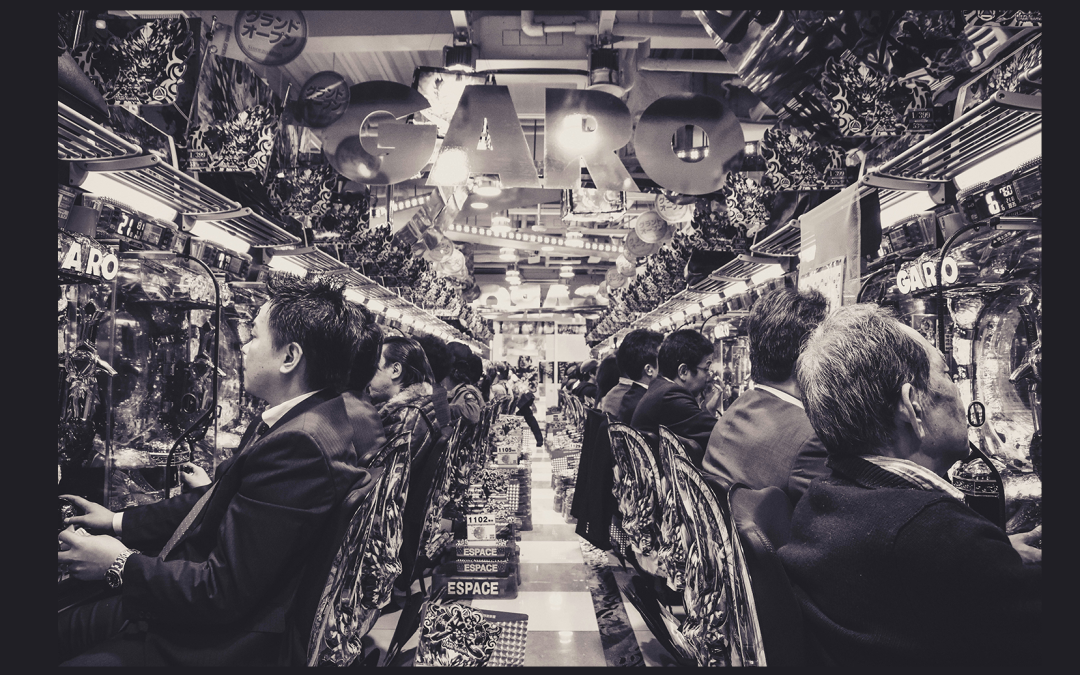
Chinese pinball, or Pachinko, has its origins in Japan, but unlike Western pinball, it is still widely used for gambling in that country. Like Western pinball, there exist both manual and electronic versions of the game. The machines are vertical instead of horizontal, using smaller balls instead of the larger ones in our own machines.

With pachinko machines, a spring-loaded handle launches the small balls into a metal track, which guides the ball over the top of the playing field until it falls into the playing field. In that field are brass pins throughout, and several small cups at the bottom.

If, after bouncing around on the pins, the ball falls into one of the cups, the player wins, and multiple balls will be dispensed into a tray at the bottom as the player’s reward. If the ball doesn’t find its way into one of the small cups, it falls into a slot at the bottom of the machine, triggering a loss. Like modern-day slot machines, pachinko machines employ colorful graphics and LED lights.

In Japan, pachinko parlors used to be found in just about every large city, similar to our casinos. Those who play the machines and win take their metal balls to a parlor employee in exchange for small prizes, such as pens or cigarette lighters. And though playing pachinko for cash is illegal, many small stores nearby these parlors will allow patrons to exchange for money.

The pachinko machine first made its appearance in Japan in the 1920s, with public parlors opening after the end of World War II.

And while the number of parlors has decreased in number due to law enforcement crackdowns (many of them have been infiltrated by yakuza, or Japanese crime syndicates, for racketeering or money laundering), until the last decade or so, the industry was immensely lucrative one – according to Fortune, the industry in Japan garners more gambling revenue than Las Vegas, Singapore, and Macau combined.

Although these vintage machines were beautifully designed and decorated, the pachinko machines themselves aren’t very rare (though people usually seem to believe they are), with hundreds of thousands imported during the 1960s and 1970s. Machines from that period are usually only worth between $20 and $100, but the older, rarer machines can go for up to $1,000 or more.

My dad was giddy with excitement when he brought a vintage pachinko machine home from an antique store when I was a kid. My brother and I played on that machine in the basement many times, enjoying hearing the ding of bells as the metal balls bounced around the field of metal pins, our eyes carefully following them along.

We hope you enjoy reminiscing about the pinball machines of your youth as you learn about their story. It seems everyone of a certain age has one!
 

Contact Corbin Crable at editor@discovervintage.com​

Stores shine spotlight on ethically sourced, sustainable items

Stores shine spotlight on ethically sourced, sustainable items

https://firefly.adobe.com/generate/images

December 2023

Everything Old

Stores shine spotlight on ethically sourced, sustainable items

by Corbin Crable

If you’ve ever taken a leisurely stroll throughout the picturesque, quaint downtown Overland Park, KS, you likely have a small list of shops you always make sure to visit.

There’s Penzey’s Spices, where I stock up on spices from across the globe. Oh, and there’s The Tasteful Olive, a merchant specializing in olive oils and balsamic vinegars.

Who can forget Ten Thousand Villages, that small merchant selling fair-trade crafts from nearly every continent on the globe? Though not an independent business, Ten Thousand Villages does have locations throughout the Midwest. Run nearly entirely by volunteers, these stores focus on the actual stories behind the crafts they sell – the people and organizations who made them, and the countries from which they hail. Its website states, “As a pioneer of fair trade, we do business differently, putting people and planet first. That means you can trust that every purchase and donation you make directly impacts the life and community of its maker in an under-resourced community. Together we break the cycle of generational poverty and ignite social change.”

When you shop locally, you put a face on the artists who make items like crafts and edible goodies by hand. This merchant does the same, but by putting a face on the people who create them, stores like Ten Thousand Villages makes this large world of ours just a bit smaller.

In this issue, we shine a spotlight on nativity scenes, both ones we might remember from childhood and ones that tell the story of Christ’s birth with an interpretation we may have never seen before. Ten Thousand Villages is just one of many merchants that sells such items this time of year.

Shopping at such a unique vendor can not only expose us to different cultures, viewpoints, and holiday celebrations – it can make us feel good about giving a bit to a larger cause. Unlike smaller, independent merchants, you might not meet the artisan face to face, but you’re aware that your financial support of them means that someone, somewhere, wants them to thrive and wishes for them a better community, a better life. The item you buy just feels like an ancillary benefit.

We should always remember the people behind the handmade gifts we give. For some, especially those in developing countries, it might be their only source of income.

Ten Thousand Villages does an amazing job of creating a sort of connectivity between the artist and the buyer. As we hear the stories of those both physically close to us and a half a world away, we are brought figuratively nearer to them. During this time of year, that closeness is especially important

The fact that such a store is staffed mostly by volunteers shows that there are many others who likely agree with me, and they believe in that mission to better the lives of others, too. During the holiday season, such volunteerism is especially important, both to the volunteer and to the person or community that benefits from it.

If you can’t volunteer your time, your dollars can still make a difference. You can make monetary donations by visiting www.tenthousandvillages.kindful.com.


Contact Corbin Crable at editor@discovervintage.com​

Holiday celebrations made  special with cherished traditions

Holiday celebrations made special with cherished traditions

https://firefly.adobe.com/generate/images

November 2023

Everything Old

Holiday celebrations made special with cherished traditions

by Corbin Crable

Far too often, we don’t truly appreciate traditions when we’re living them in the moment. This is especially true for those traditions observed during the holiday months.

When I was little, we would spend every Christmas Eve at the home of my maternal grandparents. Often, my parents, younger brother and I would be the first to arrive (and thus the first to get to the candy dish and munch on some chocolate peanut clusters, which Grandma made every Christmas). My aunts, uncles and cousins would trickle in right before the meal was served. We didn’t carve up a ham for the entrée – no, no, we were yuletide rebels who enjoyed tender, smoked brisket on little cocktail buns instead.

But the highlight of the entire evening – well, at least for the adults – was the completion of the small nativity scene that sat under the equally small Christmas tree in the living room.

Every Christmas Eve, my grandparents would put the baby Jesus figurine in an adjacent room, and it was the job of the youngest grandchild to carry the figurine into the living room and gingerly place it under the Christmas tree while everyone else watched. Eventually, this tradition evolved, and every year, the grandchildren took turns being the bearer of the savior. We grandchildren joked about how embarrassing the entire show felt as we shuffled our way toward the base of the tree, a chorus of “ooohs” and “aaahs” meeting our ears.

As an adult, however, I’ve come to appreciate the presence of such traditions. I know plenty of people who never had the opportunity to enjoy those with their family, and even those who didn’t have much of a family to begin with. Now, I feel fortunate that we youngsters were able to make our elders smile and feel surrounded by God’s presence. It’s still a memory my brother and I share every Christmas.

My mother’s tradition each Christmas became a Christmas Eve meal of spaghetti and meatballs, a little salute to our Sicilian heritage (for dessert, we’d enjoy a slice of sheet cake in honor of Jesus’ birthday). In recent years, I have started my own tradition of making a big pot of hearty minestrone soup (whose origins are in – you guessed it – Italy) with crusty bread and sharing it with friends. I look forward to it every year and ensure to make enough for multiple meals.

Whether your own traditions are steeped in your cultural heritage, whether they make you chuckle or even cringe a little bit, no matter how you feel about them, your sentimentality will only grow with the passing of time. And every year, as you lose members and gain others, you can keep their traditions alive or start your own. The feeling of connectedness, that feeling of family and community, that desire to make the season bright for your loved ones is all that needs to be behind the tradition itself. If you’ve created memories that others will share over the years, you’ve done your job. May you enjoy those longstanding traditions and make new ones this Thanksgiving and Christmas.

Contact Corbin Crable at editor@discovervintage.com​

Item tied to former Kansas mayor, his family

Item tied to former Kansas mayor, his family

Wallet Photo by Jonathan Duran on Unsplash

October 2023

Everything Old

Item tied to former Kansas mayor, his family

by Corbin Crable

Last weekend I enjoyed my first visit to Merchant Square in Independence, MO, where I had the pleasure of interviewing Jace Sanders, the antique mall’s owner.

Before approaching the front counter to meet him, I browsed the aisles (each one named after a street, attraction or famous person associated with the area). In a booth within the ‘Harry Truman’ aisle, I came across a small item, which I have found myself researching ever since.

It was a brown leather wallet, stamped with an art deco pattern on its exterior. The inside of one of the wallet’s folds was simply stamped ‘B.F. McLean’ in gold letters. And inside one of the pockets, I found the following note, written in neat, capital letters:

Benjamin Franklin McLean, grandson of Wichita founding father Benjamin Franklin McLean. Ben was killed in the Battle of the Bulge in World War II.

For the past year, I had been telling myself that I needed a new wallet – mine was looking pretty ratty and in poor condition. Maybe this newfound treasure would prove to be a conversation piece.

Maybe this newfound treasure would prove to be a conversation piece. Only my friend Google would make that determination. At just $20, I snatched up the wallet and took it to the front counter, anxious to begin learning its story – or at least the story of the person who owned it.

When I got home, I Googled the name in the wallet and found that Benjamin Franklin McLean was born in 1858 (in Canada, no less), worked as a banker, and served twice as the mayor of Wichita (once in 1901-04 and again for a year, from 1923-24. McLean’s son, Benjamin Drew McLean, himself a Harvard graduate, bank officer and World War I veteran, married Elizabeth Anna Mabry, a fellow Canadian, in 1919; he took the helm of his father’s bank in 1930, when McLean Sr. died. The younger McLean and his wife would eventually have five children, one of whom, Ben (their only son and the owner of the wallet), was born in 1921. Not much else is documented about Ben other than he enlisted in the service toward the end of World War II and died during the Battle of the Bulge in early 1945. He was survived by his wife and a young daughter.

Tragedy almost struck the family again in 1956 when Drew and Elizabeth’s daughter, Julianne, a rising concert pianist, was rescued from the doomed Italian luxury liner the Andrea Doria before it sank off the coast of Nantucket in the Atlantic Ocean.

A testament to the McLean family’s influence in Kansas’ most populous city stands there today – a fountain, built in McLean Sr.’s honor in 1934, four years after his death, when his grandson would have been just 13. The Ben F. McLean Fountain can be found in Wichita’s Delano Park.

I tell this story only to share my excitement at finding an item at an antique store that carries with it evidence of its history, told in the form of a short letter, which I plan to keep. If only more items we find at such stores, markets and estate sales could tell us their stories, too. This one felt like pure luck.

I hope you learn as much about your next find as I did about mine. Such discoveries aren’t just delightful. They’re invaluable.
If anyone from the McLean family can share more about our fallen hero Ben McLean, or if any of the information listed in this column is incorrect or requires clarification, please don’t hesitate to contact me. It will be a pleasure to connect with you.

Contact Corbin Crable at editor@discovervintage.com​

Items crafted in Occupied Japan were designed to kick-start postwar economy

Items crafted in Occupied Japan were designed to kick-start postwar economy

Photo by Tianshu Liu on Unsplash

September 2023

Everything Old

​Items crafted in Occupied Japan were designed to kick-start postwar economy

by Corbin Crable

Made in Japan

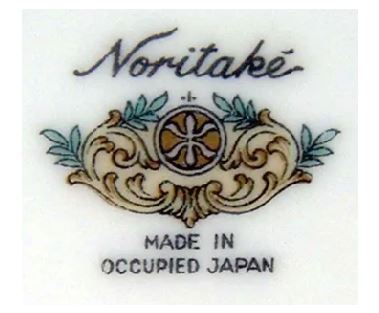
If you’re a collector of ceramics and porcelain, it’s likely that you’ve checked on the bottom of that item you browsed in your local antique store, searching for information on the company or artist that made it. Sometimes, you might have been greeted by a stamp that simply read, “Made in Occupied Japan,” (often abbreviated as ‘OJ’), “Made in Japan,” or “Japan.”

Items bearing that stamp come from a very brief but interesting time in the history of both our country and Japan itself. According to the U.S. State Department, Japan surrendered to Allied forces on Sept. 2, 1945, just a few weeks after the bombings of Hiroshima and Nagasaki. The war left Japan’s economy devastated, and the U.S. led the Allies in occupying and rehabilitating the country. That occupation lasted for nearly seven years, from the fall of 1945 to the spring of 1952. In order to make money during those years, many artists and crafters made small collectibles like porcelain figurines, which then were sold abroad. Just like today’s items made in Japan, these collectibles, which weren’t just limited to ceramics like planters and ashtrays, or porcelain figurines, were cheaply made, and chipped or broke easily.

made in Occupied Japan

Reproductions have been made of these items, too, flooding the market since roughly the 1980s.

OJ collectible

Thankfully, both in-person and social media groups of collectors of these items have popped up, too, giving collectors a place to discuss, buy, sell, and trade. If in doubt about the authenticity of an OJ collectible, always take your item(s) to have it evaluated and appraised by a professional. You also can test these items yourself – one way to test a porcelain OJ item, for instance, is to look at the OJ marking, which should have been put on under the porcelain’s glaze. If you rub nail polish remover over the mark and it comes off, you know it’s a reproduction.


The bad news is what you likely have already suspected – these items, due both to their quality and their widespread availability, are largely worthless, the steep decline in worth having taken place over the last 30 years or so. A cursory search of OJ items for sale online proves this, showing many OJ porcelain items and pottery worth only a few dollars. Still, I’m a sucker for the power of nostalgia, which has led me to hang on to items that likely have low monetary worth but are strong in sentimental value. If you’re reading this publication, I have to assume you understand how this feels.

If you’re a collector of OJ items or would merely like to know more about them than I can provide in this space, a welcome resource is the Facebook group “Occupied Japan Buy Sell Trade,” where you can socialize with like-minded folks. If you’re not on social media and would instead prefer a book recommendation, your most up-to-date resource would be “Occupied Japan for the Home” by Florence Archambault. This slim tome, packed with color photos and a price guide, is available through Schiffer Publishing’s website at www.schifferbooks.com

Happy collecting!


Contact Corbin Crable at editor@discovervintage.com​