America’s greatest hits – quilting edition – Part II

May 2025

Covering Quilts

America’s greatest hits – quilting edition – Part II

by Sandra Starley


Creating a presentation on 250 years of American Quilting and Quintessentially American Quilts for the American Quilt Study Group was a fantastic opportunity to study our amazing quilt heritage. Again, I would love to share pictures of all the epic quilts that I reviewed, but instead I will give you an overview. I hope you will be inspired to follow up and start searching using the keywords I share below. Americans did not create quilting, but we have definitely made it our own!

The Flowering of American Quilts 1840-1870:
Time of Growth, Industrialism, and Westward Expansion

This is the period when American Quilting really developed its personal identity. Mid-century quilters expanded upon the signature album or friendship quilt phenomena that began in 1840. It blossomed with the detailed Baltimore Albums, one of the icons of quilting. Chintz applique was transformed from medallions into blocks used in signature quilts. And speaking of blocks, the block format especially pieced blocks of stars with alternating plain blocks began to develop as a uniquely American style. Elaborate red and green appliqué are classic patterns of this era. Red and green were popular home décor colors that translated to quilts, both appliqued and pieced. This was also the start of published patterns and more fabric being produced in America. Most importantly, the time-saving marvel of the sewing machine was becoming available to the public.

The Grand Epoch 1870-1900:
Centennial Celebration for a Grown-up Nation

It is difficult to really convey the extant of the enthusiasm and significance of the Centennial Celebration to this seasoned nation. Those of us who remember the Bicentennial know a bit about Centennial fever, but the quilters of 1876 really took the commemoration up to the nth degree. There was a frenzy of piecing and competition to see how many different pieces could be utilized in a single quilt. Fabric was so accessible that makers could easily make quilts with 1,000 or even a celebratory 1,876 separate fabrics. Patriotic fabric with symbols of the American Revolution and dates of 1776 and 1876 were extremely popular. If you find a circa 1880 charm or scrappy quilt, be sure to look closely for a Centennial fabric! Piecing was king during the period, mostly due to the availability of sewing machines.

Crazy for quilting

This period also gave birth to the most widespread quilting craze of all time: the Crazy Quilt. These wonderful works of velvet, silk, and satin covered with elaborate embroidery began in the early 1880s, and after just a few years, ladies’ magazines were complaining about the obsession they had created. In 1890, Good Housekeeping said:
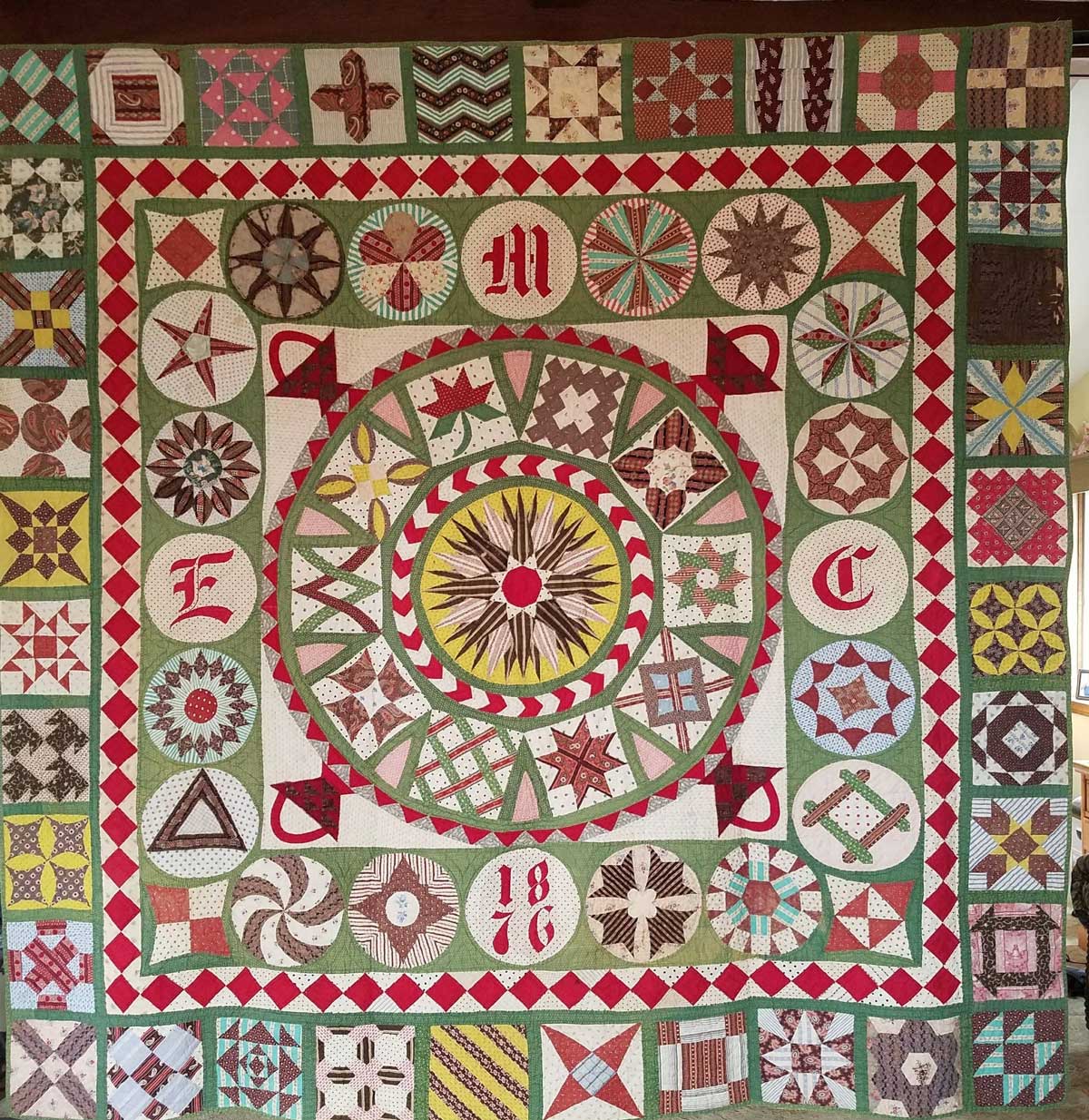
 

An 1876 Sampler Block Medallion from the collection of Barbara Menasian. (Image courtesy of Barbara Menasian)

“But make it she must,
She will do it or bust,
Beg, swap, and buy pieces or get them on trust,
Oh, the Crazy-quilt mania, may it soon cease to rave
In the land of the free and the home of the brave.”

Clearly, the rise of fabric production in America combined with increased industrialization resulted in more access to fabrics and tools and leisure time to indulge in creative sewing. Patterns were being widely published and sewing machines were common. All of this led to a democratization of sewing. Quilting was finally a pastime available to the masses, not just reserved for upper middle class to the wealthy.

Tune in next month to learn about all the exciting developments in American quilting from 1900 onward, including the rise of quilt designers and the business of quilting. More celebrations ensued, including Washington’s 200th birthday, the Bicentennial, and the Millenium and Y2K quilts.
America’s greatest hits – quilting edition – Part I

April 2025

Covering Quilts

America’s greatest hits - quilting edition - Part I

by Sandra Starley


In crafting a presentation on 250 years of American Quilting and Quintessentially American Quilts for the American Quilt Study Group, I had a wonderful history refresher course, as well as a deep dive into the treasure trove that is our quilting history. I would love to be able to share photos of all the amazing, quilted works of art that I have viewed recently. But since this is not a photo journal, I will have to paint word pictures instead and give keywords so that you can follow along with simple searches in your favorite search engine. While the roots of quilting did not begin with European settlers in North America (they extend far back to Asia, Egypt, and Medieval Europe), those roots were fostered in the fledgling country and slowly began to flourish resulting in unique masterpieces celebrating a new nation.

Early Quilting 1750 to 1800 Colonial America, The New Republic

Despite commonly heard myths developed from the Colonial Revival of the beginning of the 1900s and Bicentennial fever in the 1970s, there was little quilting done in the colonies. Pilgrim ladies did not spend their evenings at the quilting frames. Fabric was scarce and expensive and/or labor intensive and there was little spare time for decorative sewing when essential home sewing consumed the majority of the women of the household’s time. Most homes relied on woven blankets and simple woolen wholecloth quilts. Think of the challenge of making quilts at a time with no electric lighting, no sewing machines, and no access to affordable fabric. Most quilting done during this period was the preserve of wealthy women who had the resources and time to afford the luxury pastime. Quilts of the era include whitework (heavily quilted), indigo resist, chintz, palampores (Tree of Life), medallions, and simple piecing.

Quilts of the New Nation 1800-50 Pre-Industrial America to the Rise of the Cult
of Domesticity

This period was all about the fancy fabrics (think chintz, toile, indigo resists) with a carryover of whole cloth quilts and simple piecing and quilting (except in plain whole cloth quilts). Quilters recycled and pieced older bed curtains into decorative whole cloth quilts which needed little quilting. They also used fancy fabrics in simple geometric patterns, literally creating the building blocks of “The American Quilt.” Think One Patch, Four Patch, Nine Patch, Double 4 Patch, and Double 9 Patch; triangles pieced into stars and Flying Geese. There were many pieced with plain alternating blocks or set in long vertical strips alternating with fancy toiles or chintz. It was a time of a lot of change with Westward Migration, and Great Religious Awakenings, to name a few. With increasing mechanization, there was more free time for quilting and many fabrics available to purchase. More quilts were made in the second quarter of the century than any time before. Quilting was still generally reserved for upper middle class to the wealthy.


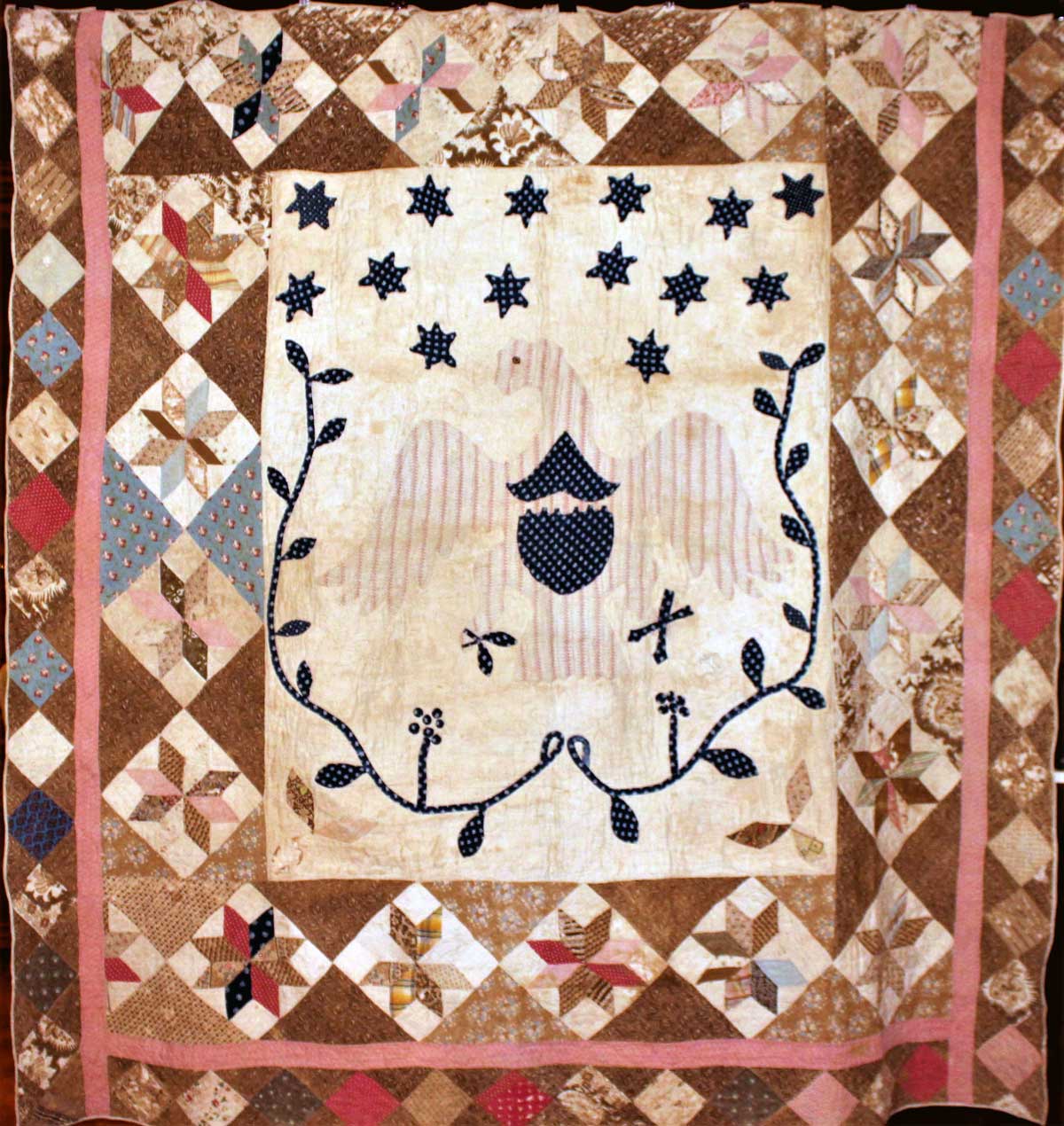
An American Eagle Medallion, c. 1845. From the Starley Quilt Collection. (Image courtesy of the author)


Red and green quilts with elaborate applique were extremely popular. They were arranged in the now classic four-block quilt and as nine-blocks or as large central Medallions. There was a great deal of growth in styles. A highlight of the 1840s is the phenomenon of signature or friendship quilts which started in about 1839 in Western New Jersey and neighboring Philadelphia, PA. Shortly thereafter the most beautiful intricate quilts ever made, Baltimore Albums, were developed in Baltimore, MD – quintessentially American quilts!

Tune in next month to learn about all the exciting developments in American Quilting from 1850 onward, including the excitement surrounding the Centennial Celebration in 1876.


Sandra Starley is nationally certified quilt appraiser, quilt historian, and avid antique quilt collector. She travels throughout the U.S. presenting talks on antique quilt history, fabric dating classes and trunk shows as well as quilting classes. Learn more at utahquiltappraiser.blogspot.com. Send your comments and quilt questions to SandraStarley@outlook.com

The MAINE Event– Quilty adventures with the American Quilt Study, Part 3

March 2026

Covering Quilts

The MAINE Event– Quilty adventures with the American Quilt Study, Part 3

by Sandra Starley


Every fall, quilt historians and other people who love old and new quilts attend the annual meeting of the American Quilt Study Group (AQSG). So much happens during the event that I need three columns to share just a bit of the amazing 2025 Seminar in Portland, ME. The first column focused on the wonderful tours of historical sites in and around Portland and the capital of Augusta. I also highlighted the wonderful Maine Quilts exhibit and the bed turnings, both of which highlighted the unique quilt styles of The Pine Tree State. The second column focused on the scholarly paper presentations, which can be accessed in Uncoverings through AQSG along with the other interesting speakers and entertainment, including the live auction with dancing maritime Juliettes and a sea shanty group. Please see the prior columns to learn more (November 2025 and January 2026). They give just a glimpse of how magical those several days were in the Portland Harbor (great sunrises and sunsets) but there was so much more: study centers, a silent auction, show and tell, and the vendors mall.

Observe, share, and learn: study centers

First, what is a study center? It is a two-hour interactive discussion of a specialized topic. It involves a Powerpoint presentation as well as actual quilts or fabrics shared by the presenter and brought in by attendees. These sessions are small and allow for more dialogue between participants and study center leaders; 2025 Study Centers numbered more than a dozen and covered a very wide range of topics and several centuries, from an up-close study of an 1825 hexagon quilt, an interesting study of two antique quilts made at the same time but now looking quite different, crazy quilts and redwork embroidery.

Then it was on to the 20th century, with seminal designers like Bertha Stenge and Marion Whiteside and quilts series published in newspapers. There was also a foray into shipwrecks and salvaged fabrics from Rhode Island. We then moved straight to the future, with centers focused on sharing quilts in the digital age and harnessing AI to be your robot quilt research intern.

Myriad antique quilt and fabric acquisition opportunities

Most of my fellow seminar attendees are at least casual collectors of antique textiles, while many are avid collectors, and seminar gives us many options to expand our collections. The vendor’s mall is comprised of some of the most esteemed national quilt dealers, smaller sellers, and those new to antique sales. Imagine the best quilt museum and being able to get up close and touch the art and even buy a piece that captures your heart. It did not disappoint. After years of searching, I found my unicorn, an intricate pieced block called Biloxi. You never know what you will find there.


A stack of wonderful Maine quilts, courtesy of the Maine Historical Society. (Image courtesy of the author)

The silent auction room was packed with beautiful quilts, quilt tops, blocks, fabrics, etc., donated by members and available to bid on and buy. Likewise, the endowment table featured a delightful mix of antique and reproduction fabrics and other tidbits to purchase and support the long-term funding of AQSG. The annual show-and-tell event featured several stunning and unique items. And finally, book sale and signing offers members the chance to purchase books authored by fellow members to increase their knowledge of prior acquisitions or to encourage new collections.

I hope this inspires you to join the American Quilt Study Group and come to Lincoln, NE, for Seminar 2026. Also, visit their website to attend the virtual Winter Seminar – March 12-15, 2026.

Sandra Starley is nationally certified quilt appraiser, quilt historian, and avid antique quilt collector. She travels throughout the U.S. presenting talks on antique quilt history, fabric dating classes and trunk shows as well as quilting classes. Learn more at utahquiltappraiser.blogspot.com. Send your comments and quilt questions to SandraStarley@outlook.com

The Maine Event – Quilting adventures with the American Quilt Study Group

February 2026

Covering Quilts

The MAINE Event – Quilty adventures with the American Quilt Study, Part 2

by Sandra Starley


A highlight of every year for lovers of quilt history (old and new) is meeting to share research, treasures, and friendship at the Annual Meeting/Fall Seminar of the American Quilt Study Group (AQSG). Last month, I shared some of the wonderful experiences I had visiting 2025’s meeting held in the coastal beauty of Portland, ME, with tours of the area and a visit to Wiscasset: “Maine’s prettiest village.” It was an amazing event full of old and new friends and a lot of antique quilts. In the previous article, I focused on the off-site tours, but there are many terrific events at the host hotel included with seminar registration. They included Early Maine Signature Quilts, a Special North Carolina Pattern, another Southern Design, an AQSG Icon, to Environmental Messaging Quilts of the21st Century.

One of the highlights of every year’s seminar are the scholarly paper presentations. These are peer-reviewed research papers showcasing “the most recent advances in quilt-related research.” They are presented at seminar and published in Uncoverings, AQSG’s annual academic journal. These papers represent years of intense research by the authors who must condense that information into their paper and then further distill the material to a brief power point talk at seminar. As usual, we were treated to a stellar group of talks on a variety of quilt history, both past and present as indicated above. It was a delight to learn details about such a wide range of topics and time periods, from mid- to late 1800s signature quilts made in Cumberland County, ME, where the seminar was held.

And on to the unique floral appliques on golden yellow backgrounds that hail from Alamance, NC. We learned more about another wonderful Southern pattern, the Harlequin Star. It was also interesting to hear about one of our founding members, Lucy Hilty, and her quilting life.

And lest you think quilt history is only about antique quilts, we saw the “transformational power” of environmental quilts being made today. So much to digest. Luckily, we all took home a copy of Uncoverings with the research papers.

Great food and Entertainment

Seminar also features great food paired with informative luncheon and dinner speakers. This year we enjoyed a keynote speech by independent scholar Lynne Basset on “Embedded: Quilts as Messengers.” Fellow appraiser Pam Weeks shared the “Long and Winding Road” of her life’s journey to quilting with a lot of skiing along the way. There was a special presentation by Elaine Yau, A’donna Richardson, and Julie Silber speaking on Routed West: Twentieth Century African-American Quilts in California and how the Berkeley Art Museum acquired a seminal collection (check out the amazing book Routed West).

Speaking of entertainment, yours truly along with my fellow Juliettes donned nautical costumes (Sandy Starfish, Kathy Cray-fish, Lenna De Marlin, etc.) in honor of Maine as part of the Live Auction along with the auctioneering pirate duo (Dana Balsamo and Julie Silber).

We, the high-kicking sea people, assisted in the auction along with engaging the crowd. Our outrageous outfits and dancing made for a lively evening and helped raise serious funding for AQSG thanks to our generous members. But the highlight was the sea shanty band headlined by our own sea shantress, Mea Clift. There were wonderful antique and contemporary quilts up for auction, along with treasures from beloved Maine quilter Judy Roche.

Tune in next month to learn about the study centers, the silent auction, the vendors mall, and more.

Paper presenter Laurie LaBar with a Cumberland County, ME, Album Quilt (1850) in her exhibit at the Maine State Museum (Image courtesy of the author)

Sandra Starley is nationally certified quilt appraiser, quilt historian, and avid antique quilt collector. She travels throughout the U.S. presenting talks on antique quilt history, fabric dating classes and trunk shows as well as quilting classes. Learn more at utahquiltappraiser.blogspot.com. Send your comments and quilt questions to SandraStarley@outlook.com

Divine inspiration: Bible stories depicted in quilts

November 2025

Covering Quilts

Divine inspiration: Bible stories depicted in quilts

by Sandra Starley


For decades, the Bible has been an inspiration for quilters who depicted stories from its pages in cloth. Among them - the Song of Solomon’s Rose of Sharon, King David’s crown, the guiding Star of Bethlehem, as well as many other Bible inspired blocks. In the 1800s, the Bible was one of the few books accessible to quilters across all societal levels, so it’s not surprising that it sparked many quilted creations.

Harriet Powers’ Bible Quilts

One of the most famous and unique Bible quilts from the 1800s is the “Bible Quilt” made by Harriet Powers (1837-1910) in about 1886 and exhibited by her at a grand fair in Georgia that year. Harriet was born into slavery in Georgia and would never have imagined in her wildest dreams that her work would eventually be housed in the Smithsonian (National Museum of American History) in Washington, D.C. She used a whimsical, folk-art style to depict appliqued human and animal images from both the Old and New Testament. She described her quilt as showing “Adam and Eve in the Garden of Eden, a continuance of Paradise with Eve and a son, Satan amidst the seven stars, Cain killing his brother Abel, Cain goes into the land of Nod to get a wife, Jacob’s dream, the baptism of Christ, the crucifixion, Judas Iscariot and the 30 pieces of silver, the Last Supper, and the Holy Family.”

Harriet also created a second appliqued folk art Bible quilt referred to as her pictorial quilt which is in the Museum of Fine Arts in Boston, MA. Collecting note: a Smithsonian licensee reproduced Harriet’s Bible Quilt in China in the 1990s, and with a bit of searching you too can own your own replica Bible Quilt. If you want to learn more about Harriet and her quilts, pick up a copy of Kyra Hicks’ This I Accomplish.

Ruby McKim’s Bible History Quilt

The Bible continued to inspire quilters into the 1900s, and it clearly guided early quilt entrepreneur Ruby McKim to develop a 24-block embroidered quilt pattern named the “Bible History Quilt.” First published in 1927 in The Kansas City Star newspaper and other publications as a special weekly feature printed in the Sunday edition. A simple outline embroidery pattern (line drawing) was published each week.

The quilter had to get all 24 editions to complete the quilt. The series depicts an assortment of Bible stories, including the well-known and easy to decipher, such as: Adam and Eve (“Father Adam” and “Mother Eve”), Noah’s Ark (“The Ark”), and Baby Moses in the Bulrushes (“Moses adopted by Pharoah’s Daughter”). Also shown are more obscure stories that may send you back to the Bible, Sunday School, or at least to Google. These include a man being fed by birds (the prophet “Elijah and the Ravens”), a man releasing water from a rock (Moses and “The Rock of Living Water”), two men carrying large fruit on a pole (“The Spies”), and a man with a piece of fabric or a pelt (“Gideon and the Fleece”). 


Harriet Powers’ Bible Stories Quilt. Image courtesy of the Smithsonian National Museum of American History


All the blocks are from the Old Testament, which causes one to wonder if Mrs. McKim planned to do a second Bible History quilt featuring images from the second half of the Bible, the New Testament.

If you are now feeling inspired to create your own Bible story quilt and wish you had a pattern, you are in luck. Ruby McKim’s granddaughter Merrily McKim Tuohey is offering the Bible History pattern, as well as many other wonderful McKim quilt patterns and books, at her website, www.mckimstudios.com.


Sandra Starley is nationally certified quilt appraiser, quilt historian, and avid antique quilt collector. She travels throughout the U.S. presenting talks on antique quilt history, fabric dating classes and trunk shows as well as quilting classes. Learn more at utahquiltappraiser.blogspot.com. Send your comments and quilt questions to SandraStarley@outlook.com