
Old-time winter adventures remembered
February 2026
Vintage Discoveries
Old-time winter adventures remembered
by Ken Weyand
Rural Missouri in the 1940s offered challenges for a youngster. Our farm was separated from the nearest village (and paved highway) by four miles of dirt roads. Winter snows – and the resulting mud -- often left us isolated. But winter also inspired new adventures. Being an “only child” had its advantages, but it meant having to do most of my “exploring” on my own.
My parents gave me the run of our farm at an early age, even before I was a first-grader. I recall one frosty morning I decided to take a walk in the snow with my sled, an ancient fixed-runner from my mother’s childhood. I think I may have taken my teddy bear as a passenger, and plodded about a mile, to a one-lane bridge. When my dad finally tracked me down, I was seated on my sled at the edge of the bridge, admiring the frozen creek about 20 feet below.
A year or so later, my dad announced he intended to walk into town to pick up our ’39 Chevy, that was being repaired in a local garage. Thinking he had left without me, I hurried to catch up. After a couple of miles, I began to assume my dad had too much of a head start, but I kept going. When I finally reached the garage, it was closed. Disappointed, I began my four-mile return walk to our farm, as the setting sun turned to twilight, and it began to grow dark. I got to the creek bridge I’d explored with my sled a year or so earlier when I met my dad, who was on horseback. After a thorough scolding, I was hoisted onto the horse, and he took me home.
Country school days
Black Oak School, not far from our farmhouse, had been improved since its construction in the 1870s. The pot-bellied stove had been replaced by a furnace, and a vestibule had been added, making room for coat racks, a tiny kitchen area with a hot plate used for community oyster suppers, and a few shelves of books in one corner that served as a library.
The things that didn’t change were two privies – one for each gender -- located at opposite ends of the school grounds. On winter days a “nature call” often meant a snowy walk to an unheated privy. And sorting out the proper coats and overshoes in the vestibule could be a challenge at the end of the school day.
But a long hill near the school turned into a fine “sled run” that we were allowed to access on several snowy days. Our “noon hour” was sometimes extended a few minutes as we finished sledding and retuned to classes.
A sledding misadventure
When I was 8 or 9, my folks bought me a “Flexible Flyer” sled, a big improvement over the six-runner antique my mother had kept. Our farm was called “Hillcrest Farm,” named for the hilltop the house, barns and outbuildings occupied. To the west, a pasture area extended for about a half-mile, offering a challenging sled-run.
Earlier snows that winter had been disappointing, too skimpy for good sledding. But one day freezing rain covered the farm with a thin coat of ice. The roads were so slick our country school was even closed for the day.
My child-brain began to visualize a new adventure. The pasture west of the barn had turned into an epic sled-run. It would make the slope west of the schoolhouse seem tame. The fence at the bottom of the hill marked the end of the run, but there was a gap in the fence, offering a nice challenge for anyone wanting a longer run.
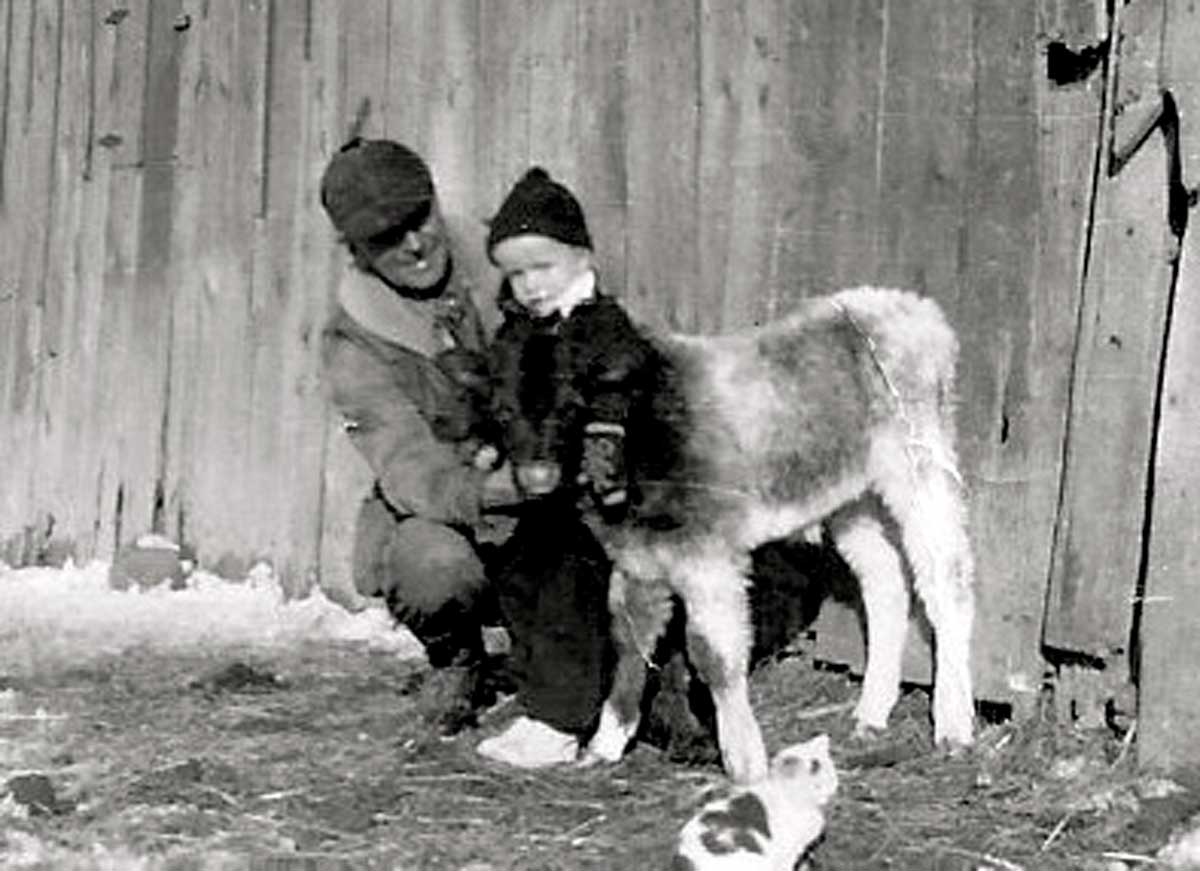
Ken and his dad with a calf, early 1940s. (Ken Weyand collection)
I approached the pasture carefully, barely able to walk on the ice-covered hill.
Occasional corncobs and small pebbles were all that made walking possible. Eyeing the gap in the fence as my destination. I took a few steps and attempted a ‘belly-flop” on the sled to get a flying start.
The adventure didn’t go as planned. My “belly-flop” failed, with the sled slipping out of my grasp and careening down the icy hill on its own. By the time I regained my footing, it had crashed into the faraway fence.
I now had to rescue my sled. Between sliding on my backside and using occasional cobs and tufts of weeds to maintain footing, I managed to reach the sled, tangled in the ice-covered fence, but intact. Now a new problem arose: getting the sled back up the hill.
After a few steps that didn’t make any progress on the icy slope, I realized I was stuck at the bottom of the hill. It was late in the afternoon, my mother would be fixing supper, and I would be in big trouble if I didn’t get back to the house soon.
Realizing the woven-wire fence was my way back, I followed it hand-over-hand and pulling the sled. The fence joined another that formed the south boundary of the field, and I continued my slow progress until I finally reached the level ground of the barn-lot.
Luck was with me, as supper was a little late. “Where have you been?” my folks asked as I entered the house. “Just playing with my sled,” I mumbled, not giving any more details than necessary. In fact, I don’t think I ever told them the entire story of my “epic sled run.”
Ken Weyand is the original owner/publisher of Discover Vintage America, founded in July 1973 under the name of Discover North.
Ken Weyand can be contacted at kweyand1@kc.rr.com Ken is self-publishing a series of non-fiction E-books. Go to www.smashwords.com and enter Ken Weyand in the search box.
Solving a jigsaw puzzle—80 years later
April 2022Vintage Discoveries Solving a jigsaw puzzle—80 years laterby Ken Weyand Bored Youngster When I was a youngster, we would occasionally spend Sundays with my dad’s stepmother and his two sisters in Hamilton, IL, across the river from Keokuk, IA. I...
Old nursery rhyme book fondly remembered
March 2022Vintage Discoveries Old nursery rhyme book fondly remembered ~ by Ken Weyand ~ My first books One of my first books – saved by my mother over the years – recently turned up in my attic. “Three Little Pigs” is a nursery rhyme classic, and it was...
Donald Duck pull toy was a 1940s hit
February 2022 Vintage Discoveries Donald Duck pull toy was a 1940s hit ~ by Ken Weyand ~ As a youngster, one of my favorite comic-strip characters was Donald Duck, a creation of the Walt Disney Co. in the 1930s. Like many of his contemporaries, Donald...
Old book charmed children in its day
January 2022 Vintage Discoveries Old book charmed children in its day by Ken Weyand “Bugaboo Bill and Other Wonders” I came across an old book the other day that has me stumped. Was it part of the accumulation of “old stuff” my parents never threw away? Was it...
Century-old high chair served three generations
December 2021Vintage DiscoveriesCentury-old high chair served three generationsby Ken Weyand The high chair, a device for aiding in the feeding of very young children and infants, has been around for decades. As a separate piece of furniture marketed to...
‘Single Tree’ was part of old-time farming
November 2021Vintage Discoveries‘Single Tree’ was part of old-time farmingby Ken Weyand Early in the 1940s, after years of “horse-farming,” my dad bought a tractor and sold his team of draft horses. Soon after that, much of the horse-drawn equipment was sold,...
Visiting Chicago’s Century of Progress Exposition, 1934
September 2019Vintage DiscoveriesVisiting Chicago's Century of Progress Exposition, 1934by Ken Weyand On Sept. 16, 1934, my mother, Mabel Weyand, and her parents, Charles and Carrie Forrester, boarded a train at Medill, MO, for Chicago to attend the Century of...
Flying ‘back in time’ in a vintage biplane
~ October 2018 / Traveling with Ken ~Vintage DiscoveriesFlying 'back in time' in a vintage biplane ~ by Ken Weyand ~ Flying in an open-cockpit biplane is a forgotten part of our history. It was an era when pilots flew "tail-dragger" aircraft from grass...
Only ghosts remain in Arkansas mining town
~ December 2017 / Traveling with Ken ~Vintage DiscoveriesOnly ghosts remain in Arkansas mining town ~ by Ken Weyand ~ Unlike the many pop-ulated hamlets that dot the Ozarks countryside, the old mining town of Rush is a true ghost town. Located 16 miles...
Thomas Hart Benton home preserves painter’s spirit
~ July 2017 / Traveling with Ken ~Vintage DiscoveriesThomas Hart Benton home preserves painter's spirit ~ by Ken Weyand ~ The Thomas Hart Benton Home and Studio State Historic Site at 3616 Belleview in Kansas City, MO, looks as if the artist might walk in...
Will Rogers’ birthplace, memorial museum worth a visit
~ December 2016 / Traveling with Ken ~Vintage DiscoveriesWill Rogers' birthplace, memorial museum worth a visit ~ by Ken Weyand ~ One of the most famous Oklahoma natives to influence American culture was Will Rogers. Known as a “cowboy philosopher,”...
Eureka Springs: Victorian jewel in northwest Arkansas
~ June 2016 / Traveling with Ken ~Vintage DiscoveriesEureka Springs: Victorian jewel in northwest Arkansas ~ by Ken Weyand ~ Before there was a state called Arkansas, the mountain community now known as Eureka Springs was already attracting visitors....