Child’s play: family-friendly ‘Play Mates’

November 2024

SMACK DAB IN THE MIDDLE

Child’s play: family-friendly ‘Play Mates’

by Donald-Brian Johnson

Hey there. . .check out this month’s Play Mate!
Now that I have your attention. . .

Once upon a time, “play-mate” meant something a lot different than it did to the gang at Playboy magazine. From the early 1930s onward, Children’s Play Mate was the publication getting all the publicity. Sure, there were competitors (Jack and Jill, Wee Wisdom, Highlights for Children), each with some of what Children’s Play Mate had to offer. But this digest-sized monthly, hailed as “The Favorite Magazine of Boys and Girls,” had it all. There were stories (“The Circle-D Kid”, “The Mystery of the Old Barn”); poems (“children of Holland, with busy feet, go clomp-clomp-clomping down the street”); puzzles (“find 10 hidden faces in this picture!”); recipes (“Barbara’s Favorite Frosty Grape Lemonade”); projects (“Make A Pumpkin Totem Pole!”); and contests (“Win A Pedigreed Cocker Puppy All Your Own For the Neatest and Most Interesting Letter!”). There was even, in that much more trusting time, “Everybody’s Mail Box,” with letters (and addresses) from prospective pen pals around the world.

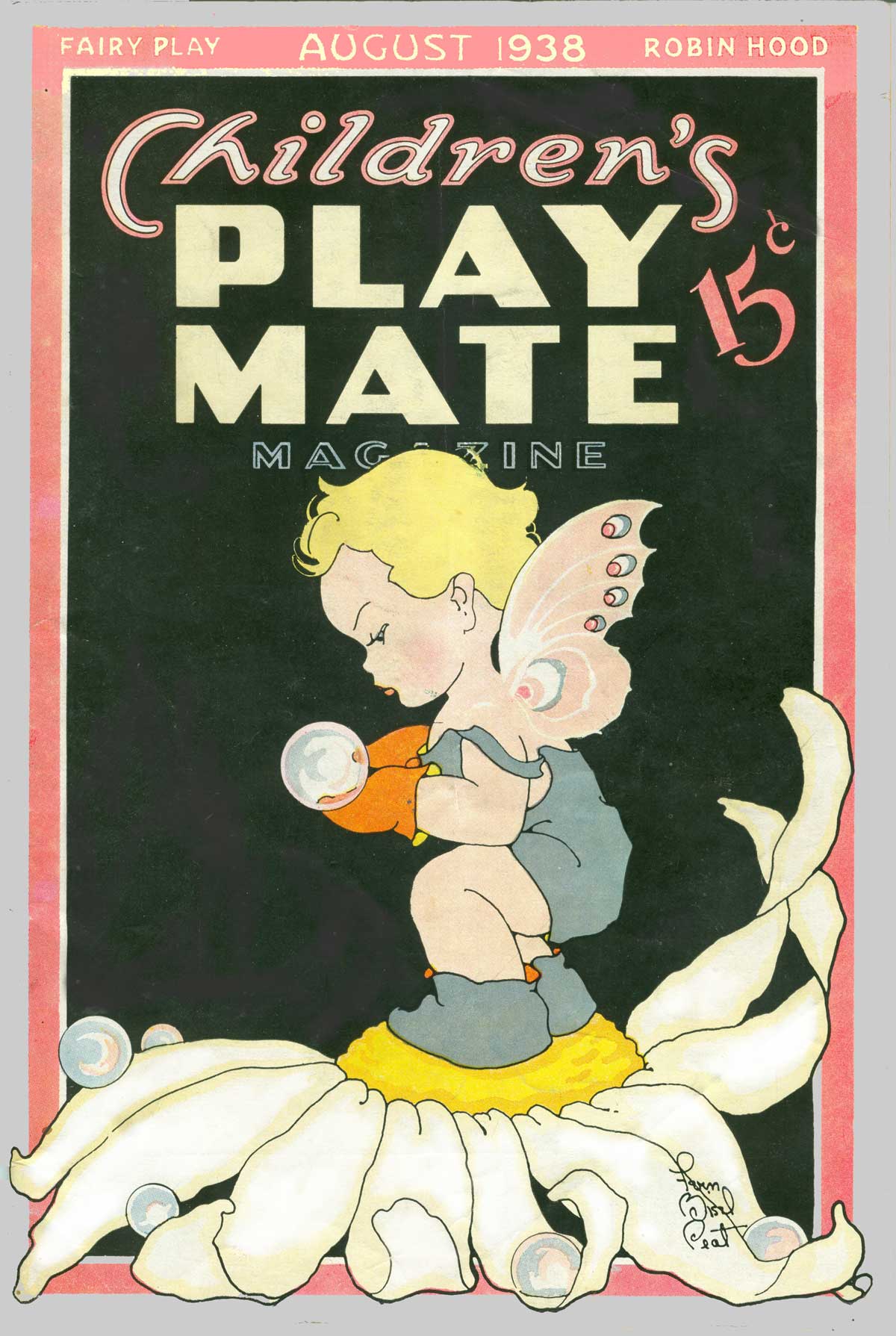
Lots more was stuffed into each issue’s 50-plus pages, which were geared to an enthralled readership “from 4 to 14.” But what primarily appeals to today’s collectors, who might not be partic-ularly interested in playing connect-the-dots or reading about “Tailspin Teena—The Little Witch Who Couldn’t Learn To Fly,” is the Play Mate artwork. Most of the cover illustrations, as well as the interior art, were the work of Fern Bisel Peat, Art Director for Children’s Play Mate from 1933 until 1955. Her unique style captures all of the era’s childhood milestones in brightly col-ored, whimsical drawings that serve as a time capsule of mid-20th century America.

A boy and a girl sail past the pine trees on their rope-and-plank swing. Another pair brave brisk spring winds to hang a birdhouse. And an angler duo peer into a pond, wondering if they’ll ever have any luck on their fishing trip. And, since the maga-zines were monthly,
Play Mate covers run right down the yearly calendar, from New Year’s and Valentine’s Day, through Halloween and Christmas.

The magazine’s visual vision-ary, Fern Bisel, was born in 1893, and graduated from Ohio Wesleyan University with a degree in fine arts. In 1917, she married Frank Peat, and the pair opened an interior decorating firm, specializing in décor items for children’s bedrooms and nurseries. In the early 1930s, the family moved to “Beech Hollow Farm,” near Bellville, Ohio, which became the home base for Fern’s artistic endeavors. There was no doubt about who lived there: the brightly colored Beech Hollow window shutters were decorated with Fern’s imaginative illustrations.

In addition to her cover paintings (a duty occasionally shared with other artists), Fern was responsible for the entire “look” of Children’s Play Mate. That included creating the artwork for the magazine’s interior color pages (puzzles, “cutout” toys, and paper dolls), as well as the line art for its many stories, articles, and promotional ads.

Bisel Peat was a versatile artist, which kept the family finances afloat during the Depression and World War II years. In addition to Fern’s magazine duties, other pro-jects included illustrating more than 60 books, among them new editions of Mother Goose and A Child’s Garden of Verses. As a freelance artist, she also designed everything from children’s toy chests, wallpaper, and room div-iders, to rag dolls, holiday decorations, playing cards, greeting cards, and coloring books. A notable assignment was for famed toymaker Ohio Art. There, Bisel Peat was the artistic force behind those Ohio Art tin toy favorites found in every reputable sandbox: pails, shovels, buckets, and watering cans.

Originally just 15 cents, vintage copies of Children’s Play Mate remain a bargain at $10 or less. Framed, the magazine’s colorful covers are exuberant depictions of childhood in America. (Even better: unlike their centerfold namesakes, Fern’s cover illustrations don’t have a staple in the middle).
Learning the ABCs, graphite, and watercolour

A winged cherub, a flower petal, and bubbles: Fern Bisel Peat’s cover fantasy for the August 1938 issue of Children’s Play Mate. (Image courtesy of the author)

Donald-Brian Johnson is the co-author of numerous Schiffer books on design and collectibles, including “Postwar Pop,” a collection of his columns. Please address inquiries to: donaldbrian@msn.com
The collecting spirit: Haunting Halloween collectibles

October 2024

SMACK DAB IN THE MIDDLE

The collecting spirit: Haunting Halloween collectibles

by Donald-Brian Johnson

The scene: a suburban basement, circa 1960. Orange and black crepe paper streamers have been carefully taped to the rafters. Cardboard die-cut images of hags, haunts, and assorted other hobgoblins adorn the walls. On the floor sits a metal tub, awash in icy water and bobbing red apples. A honeycomb scarecrow centerpiece, engulfed by Indian corn and gourds, reigns atop the refreshment table. There, a bowl of “witch’s brew” (tropical punch with a slab of steaming dry ice), and plates of “cat cookies” (with gleaming candy corn eyes and fork-tine whiskers), await the hungry hordes. Near the foot of the stairs, an eerily grinning Jack-o’-lantern awaits his prey.

And slowly down the stairs they descend: pint-size devil imps and fairy princesses, friendly ghosts and wart-nosed witches, each lugging a stuffed-to-the-brim trick-or treat bag. Their fresh-out-of-the-box costumes (dime-store bargains that even included a mask), are at last making their long-awaited, once-a-year appearance.

It’s 1960, it’s Halloween, and the party is on!

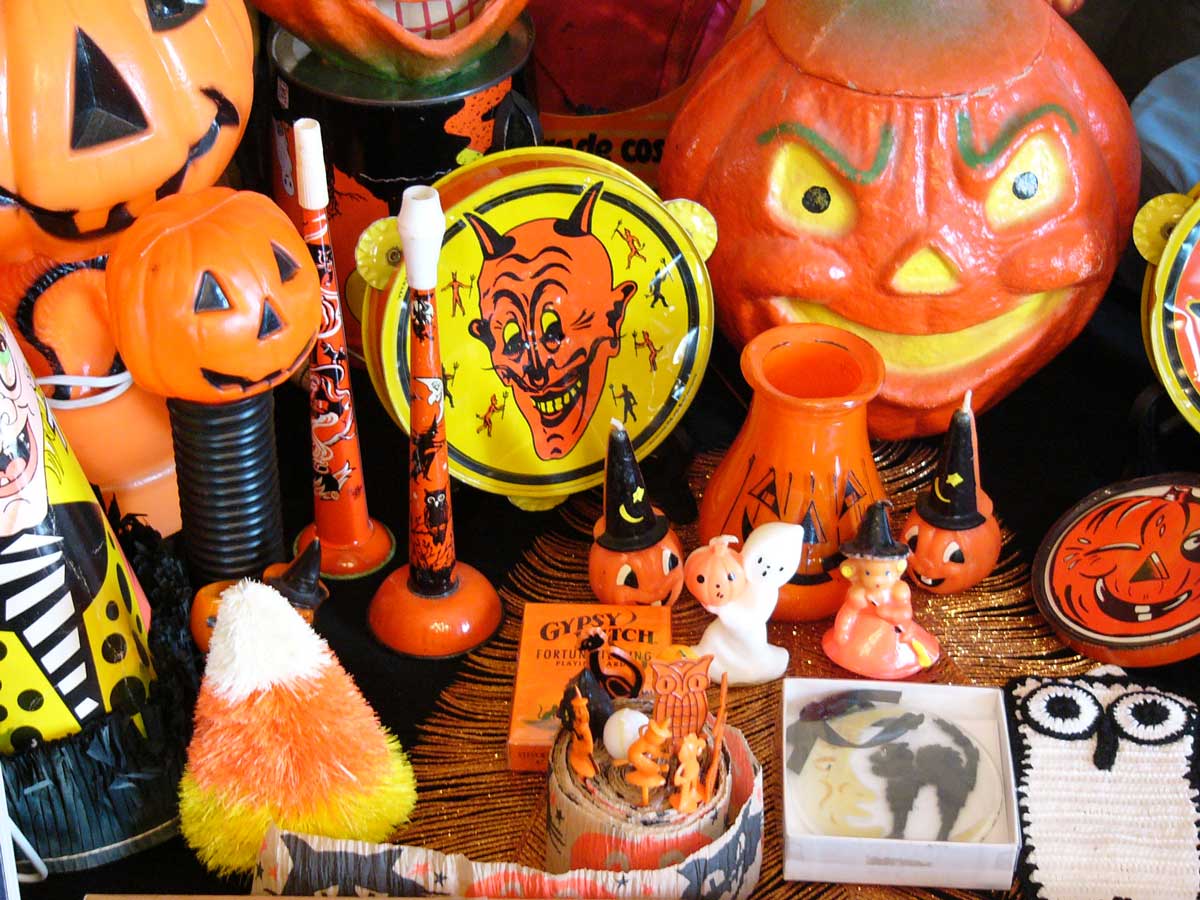
Nowadays, Halloween is second only to Christmas as the biggest decorating holiday ever. We spend more than $6 billion annually on new and vintage Halloween decorations, costumes, treats, and other paraphernalia. Over one quarter of the candy sold each year is sold at Halloween (That fills a lot of trick-or-treat bags). Halloween décor items, both old and new, have been fashioned from die-cut cardboard, crepe paper, metal, composition, plastic, fabric, wax, and ceramic. Among the most popular depictions of things that go bump in the night: Jack-o’-lanterns, witches, skeletons, bats, and black cats.

Although Halloween collectors veer toward the vintage, they sometimes have a devil of a time finding exactly what they’re looking for. The relative rarity and corresponding priciness of Halloweenabilia is primarily because these were items of ephemeral shelf life. Die-cut cardboard cats and witches with accordioned crepe paper arms and legs were really only intended for one-time use. Hung with a lavish application of Scotch tape, or poked with thumb tacks, the pieces were often damaged, then discarded when the witching hour had passed. The reason? They were inexpensive, and next Halloween would bring a brand-new crop (One party goods manufacturer, Dennison, even published, for a time, an annual “Halloween Bogie Book” featuring the latest additions to their ghoulish décor line).

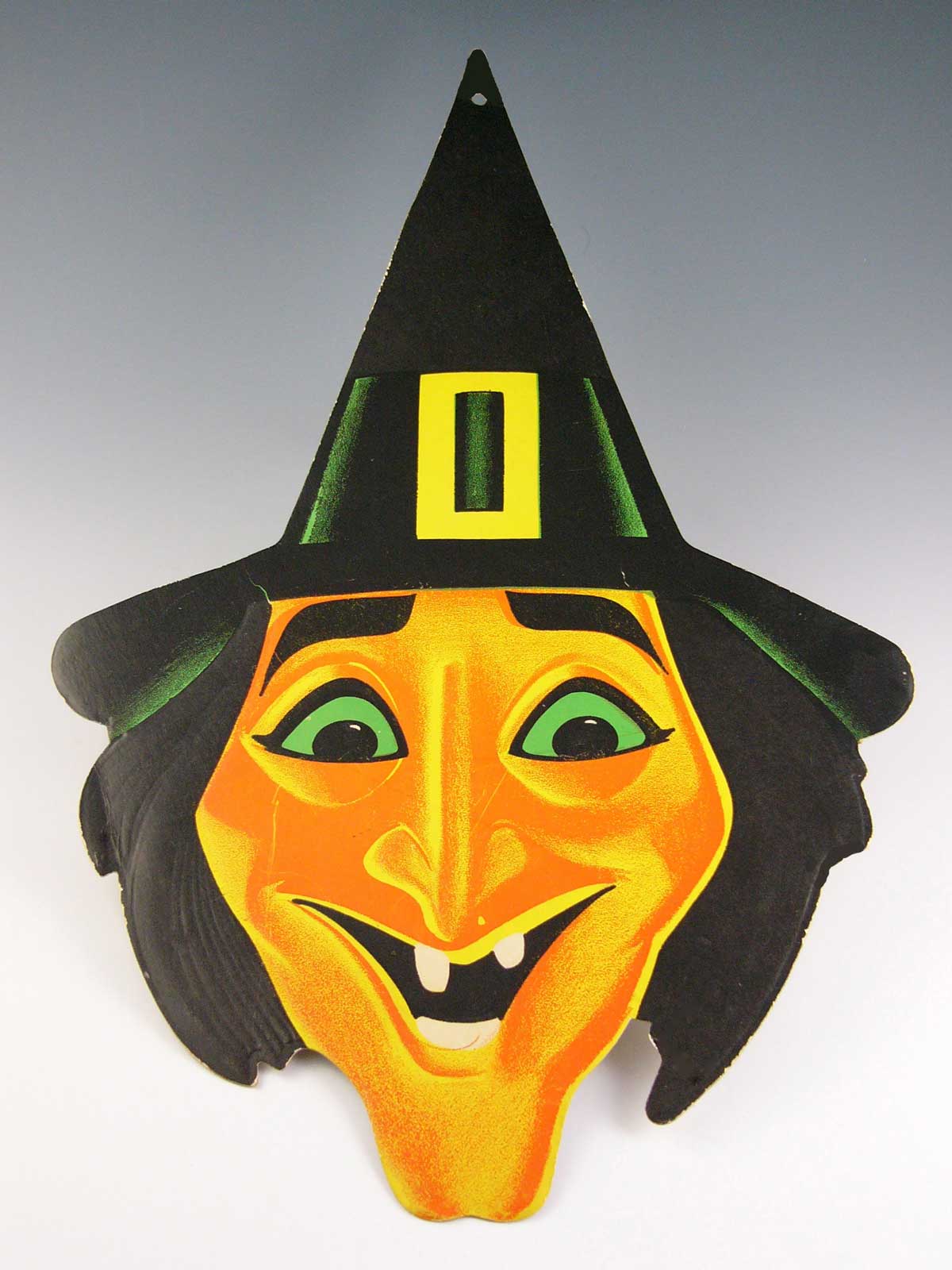
Prices can sometimes be on the scary side: a U.S.-made die-cut witch face from the 1950s can fetch up to $30. Her German-made pre-World War II sister can top out at an even scarier $150. Each originally sold at dime stores for well under a dollar.


Learning the ABCs, graphite, and watercolour

Let the fun begin! A spook-tacular assortment of vintage Halloween decorations. Collectibles courtesy of Maureen Maher. (Image courtesy of the author)

Learning the ABCs, graphite, and watercolour

Cardboard die-cut witch face, 20” h. Die-cut courtesy of Maureen Maher. (Image courtesy of the author)

Although few Halloween collectibles carry the mark of their maker, there are exceptions. Tin noisemakers often bear such stamped names as Chein, T. Cohn, and Bugle Toy. In many cases, kids’ Halloween costumes from such sources as Collegeville and Ben Cooper have interior identifying tags or are still in their original boxes. Gurley (formerly “Tavern”) candles, of spooky staples such as witches and ghosts, are also easily recognizable. That’s due not only to their singular styling, but also because Gurley pretty much cornered the marked on seasonal wax novelties. And, among the best-known, and certainly most carefully executed die-cut hanging pieces, are those by the Beistle Co. of Pennsylvania. The mark “H.E. Luhrs” (the name of the firm’s president) is a sure identifier of Beistle pieces produced during the 1940s and ‘50s.

While vintage Halloweenabilia remains today’s top draw, new decorative items incorporating vintage styling also have many fans. Like their vintage compatriots, modern Halloween interpretations are definitely for collectors not adverse to treating themselves. On the secondary market, a wire-skirted witch by 1800s-inspired artisan Nicol Sayre can reach a spellbinding $150.

When Oct. 31 rolls around, there’s magic at work. Somehow, it’s 1960 all over again. Those costumed kiddies are once again ready to make their way down into the Jack-o’-lantern’s lair. They’ll be amazed. Astounded. And maybe (just a little bit) frightened.
Halloween. What a boo-tiful occasion.

Donald-Brian Johnson is the co-author of numerous Schiffer books on design and collectibles, including “Postwar Pop,” a collection of his columns. Please address inquiries to: donaldbrian@msn.com
The old stamping ground: trading stamp tales

September 2024

SMACK DAB IN THE MIDDLE

The old stamping ground: trading stamp tales

by Donald-Brian Johnson

The Brady boys wanted a rowboat.
The Brady girls wanted a sewing machine.
And, in true Brady Bunch fashion, it wasn’t long before the whole family—even Tiger the dog—got in on the action. The Bradys had 94 books of “Checker Trading Stamps,” and those stamps had to be redeemed before the local redemption center closed its doors.

So who won? Well, you’ll have to wait until the end of this episode. . .er, article. . .to find out.

By 1970, when the Bradys were facing their dilemma, trading stamps were nearing the end of their shelf life. But, like the Bradys, trading stamps live on in pop culture (Especially in the minds of those who spent hours sponging—or, worse yet, licking—the stamps, then pasting them into savings books).

Ever since their 1891 debut at Schuster’s Department Store in Milwaukee, trading stamps traded on the Ebenezer Scrooge in all of us. For every 10 cents spent, you received a stamp, and 1,200 stamps filled a book. With enough books, the sky was the limit: you got something for nothing! In 1956, a “Big Boy Barbecue Grill” took just 7-1/2 books of S & H Green Stamps; 1961’s “Westinghouse Portable Roaster Oven” was just 11-3/5 Gold Bond books. A 24-inch “Boys’ Huffy Bicycle” set you back 15 Top Value books in 1972. In 1955, Gold Bell offered animal lovers a “Thoroughbred Live Cocker Spaniel Puppy” for 20 books. And for super-savers, if you amassed 1,000 Top Value books, a “1962 Ford Galaxie 500 Club Victoria with Fordomatic Transmission” would soon pull into your driveway!

In 1896, trading stamps really came into their own, when Thomas A. Sperry (who had the idea), and Shelly B. Hutchinson (who had the cash), teamed up to form the S & H Co. Stores bought S & H Green Stamps, then distributed them to customers with each purchase. Customers brought filled books to “premium parlors” and claimed their prizes. With S & H eventually joined by such regional competitors as Gold Bond and Top Value, trading stamp firms comfortably puttered along toward mid-century. Then, just after World War II, “puttered along” transformed into “zooming forward.”


Learning the ABCs, graphite, and watercolour

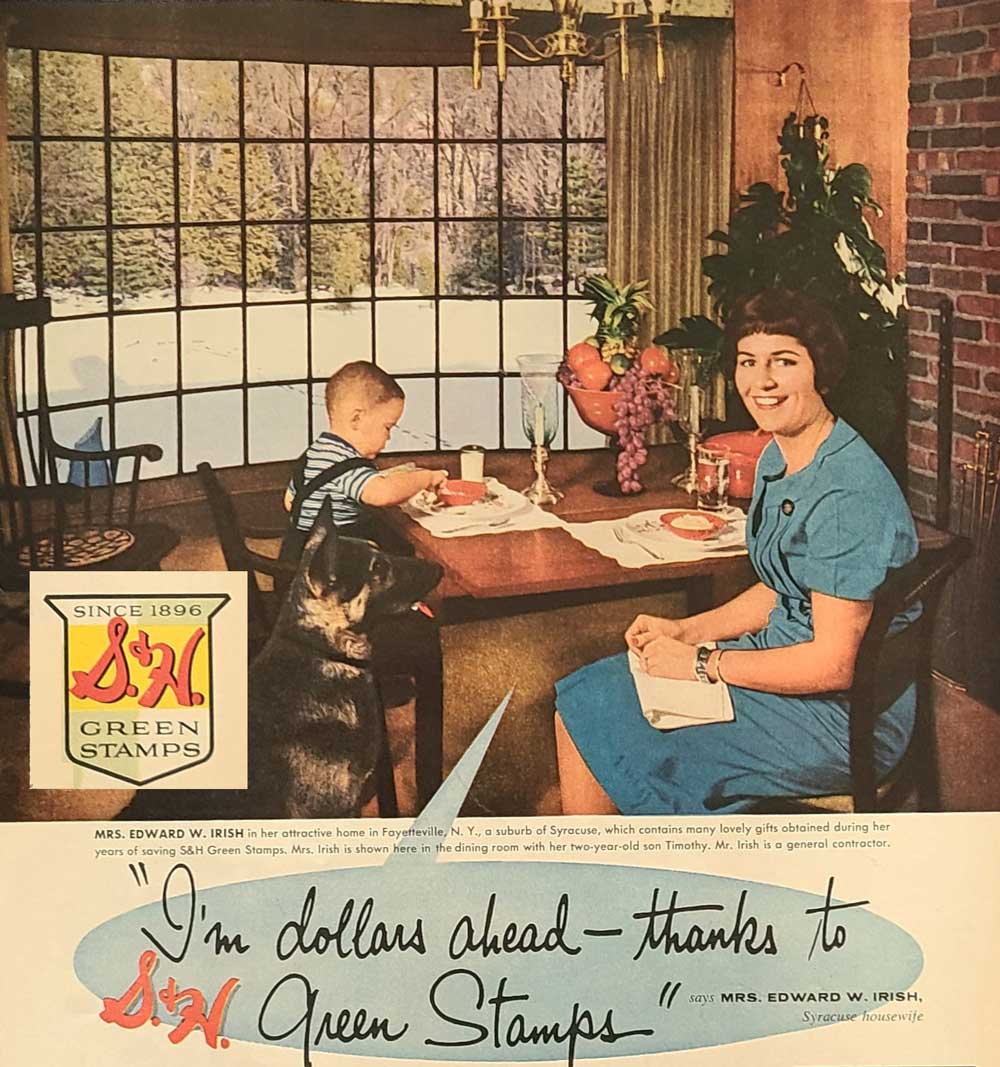
“Women learned long ago that with S & H Green Stamps, you get what you want when you want it.” S & H magazine ad, 1960.

Learning the ABCs, graphite, and watercolour

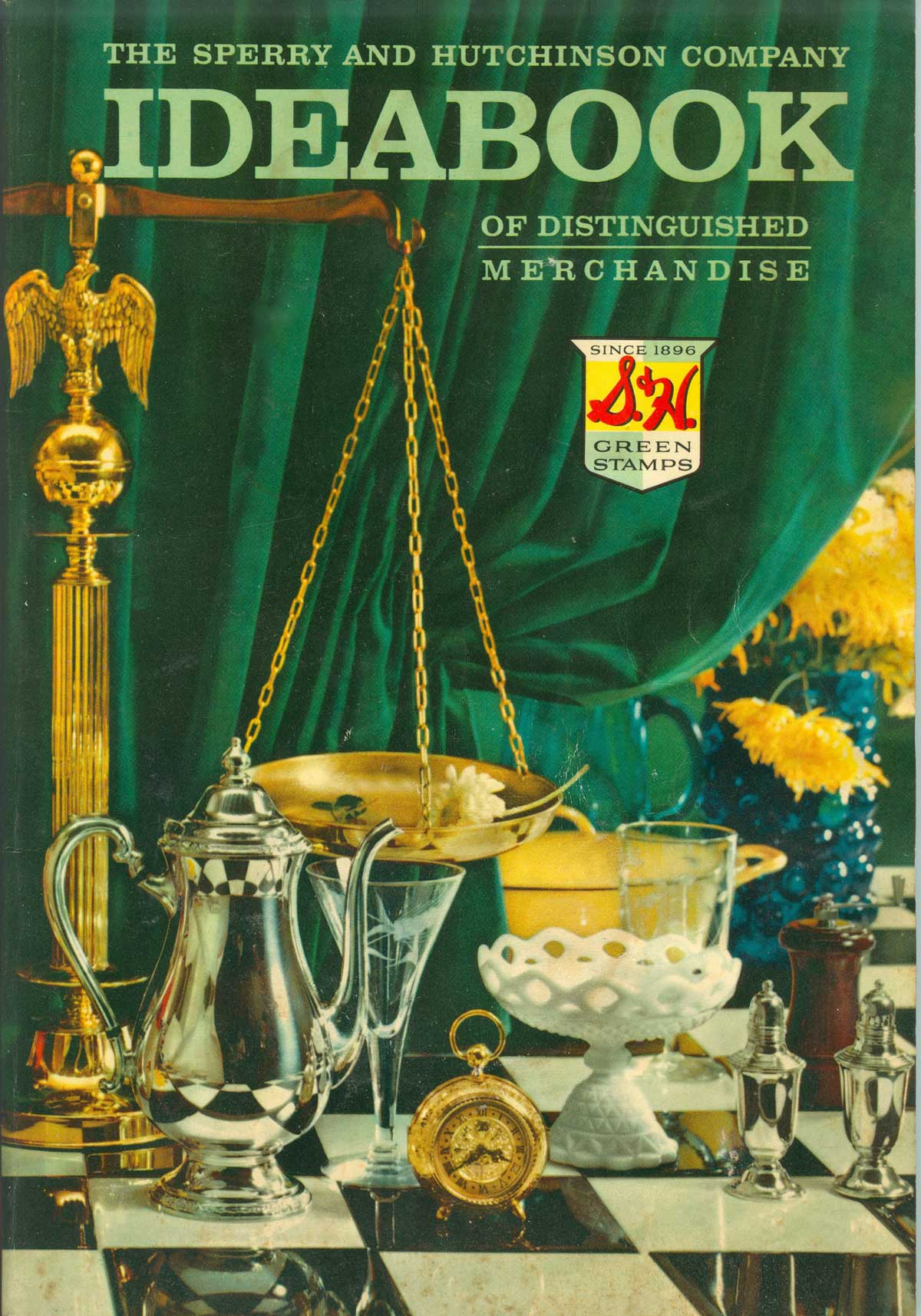
“S & H Green Stamps bring you Distinguished Merchandise from Distinguished Makers.” Ideabook cover, 1961. (Image courtesy of the author)

Buoyed by a booming economy, all sorts of stores gave their stamp of approval to trading stamps. Supermarkets. Gas stations. Drug stores, dry cleaners, feed mills, movie theatres, and even the occasional mortuary. By 1957, nearly 250,000 retailers were stamp outlets, and customers stampeded into 1,600 redemption centers. By 1964, S & H was redeeming more than one billion stamps each week. The company trumpeted that it printed more stamps annually than the U.S. government.

Some non-participating retailers labeled stamp-giving a scam. Sure, the customer got stamps—but didn’t that result in higher prices? Court cases were filed, and in most instances the plaintiffs lost. Then, in the early ‘70s, just about the time the Bradys were dithering over a rowboat or a sewing machine, trading stamps took a real licking. The growing popularity of discount stores, such as Target and Kmart, meant that paying more at non-discount retailers just to earn stamps was no longer appealing. Grocery stores dropped prices, then dropped stamps; 1973’s energy crisis stamped out any hope of a trading stamp rejuvenation. Along with free maps and friendly full service, gas stations eliminated trading stamps. Who needed them? It was an incentive-free seller’s market. The result: S & H lost a quarter of its business.

Nowadays, most retailers have their own customer loyalty programs. The last S & H grocery outlet, a Tennessee Piggly Wiggly, stamped out its program in 2003. Today, the best place to find trading stamp ephemera is online or at garage sales; most of it goes for less than $20. For a very particular breed of stamp collectors, that’s where a catalog of memories lives on.

(Oh, about the Bradys: the Bunch compromised, redeeming those 94 books for a groovy color TV!)

Donald-Brian Johnson is the co-author of numerous Schiffer books on design and collectibles, including “Postwar Pop,” a collection of his columns. Please address inquiries to: donaldbrian@msn.com
All buttoned up – Examining a fashion staple

August 2024

SMACK DAB IN THE MIDDLE

All buttoned up - Examining a fashion staple

by Donald-Brian Johnson

OK, gang. Today’s topic: buttons!

Not push buttons. Not campaign buttons. Not even Bachelor Buttons.

Nope. We’re talking honest-to-goodness button buttons. The kind without which your shirt would be flapping open and your overcoat blowing in the wind.
Those kind of buttons have been with us since ancient times. Buttons have been dug up on archeological expeditions in Egypt and Greece. Sculptures and coins dating back to the eighth century depict personages tidily buttoned up at neck and sleeve. Paintings from the Renaissance onward show their subjects in garments fashionably festooned with buttons.

Once a button served its utilitarian purpose, it was artistry’s turn. Over the centuries, a parade of possibilities has captivated button-makers and button-wearers. Among the many media employed in button creation: silver, steel, copper, brass, pewter, ivory, horn, wood, porcelain, china, ceramic, glass, carved pearl, shell, cloth, leather, and such 20th-century latecomers as celluloid, Bakelite, plastic, Lucite, and rubber. Some buttons were studded with, or formed from, real or rhinestone gems. Others featured enameled designs or reverse paintings. Sometimes the button illustrations were embroidered or done on paper, ivory, or silk, then captured under glass. Until the dawn of the Industrial Age, buttons were hand-made, fragile, and costly.

In the 1700s, buttons were a man’s game. Anything that could be buttoned was. There were decorative buttons of all sizes on waistcoats, cloaks, sleeves, and pockets. By the mid-1800s, though, men’s clothing had become less flamboyant, and ladies ruled button fashion. Thanks to mass manufacturing, extravagantly-styled buttons came within reach of almost every pocketbook.

Particularly popular were “picture” buttons, many of stamped metal, celebrating a variety of subjects. Among them: children, animals, birds, insects, angels, flowers, sporting activities, and characters from favorite stories and fables.

Fashion trends of the time were often dictated by the doings of the famous. After Queen Victoria’s husband died in 1861, her entire wardrobe, including buttons, was transformed overnight to unrelieved black. Victorian fashionistas quickly embraced that idea, and “Jet” buttons, originally fabricated from fossilized driftwood, but later from less expensive black glass, became the rage.

With the 20th century introduction of plastics, buttons could be created in almost any shape, and were. Why settle for a button with just a painting of a horse on it? If you loved horses, the winning ticket was a button which recreated a horse in full gallop.

For the beginning “button-eer,” the question is: where to start? For some collectors, the passion begins with a search for buttons just like the ones that populated Grandma’s sewing basket. For others, it’s a theme. You like dogs, and you like buttons. What you’re on the hunt for is an easy choice. Some folks are into the material used: if you adore Bakelite, but your jewelry box is already stuffed with Bakelite bracelets, the next step might be Bakelite buttons.


Learning the ABCs, graphite, and watercolour

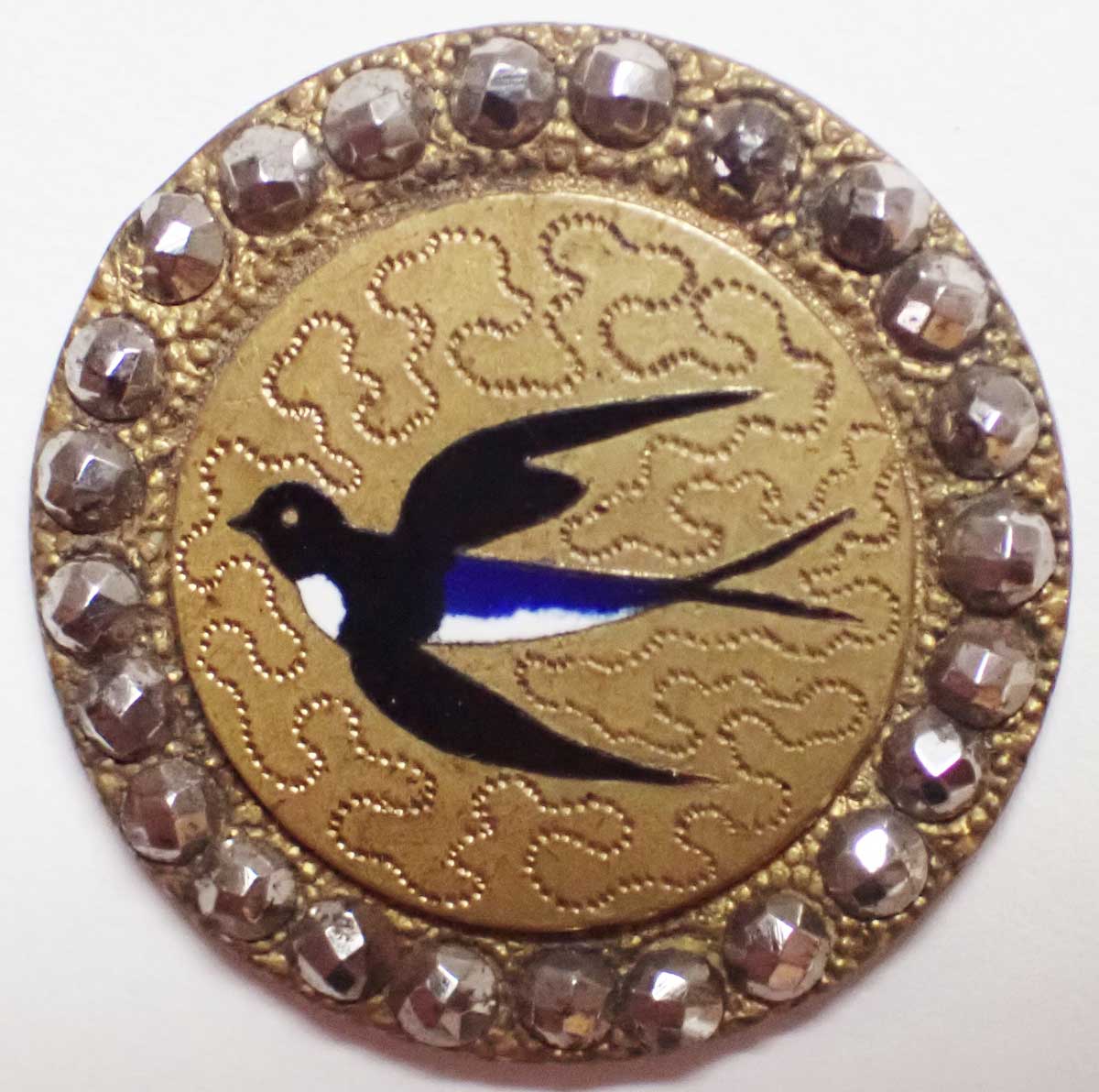
A button featuring an enamel engraved swallow, encircled by a faceted steel border. Late 19th century. (Image courtesy of Mitzi Lovell, Lisa Schulz, and Shareen Martin. Photo Associate: Hank Kuhlmann)

A favorite button subset: uniform buttons. Full regiments of military buttons exist, but many other occupations also boast specific uniform buttons. Railroad conductors, airline pilots, ship captains, and those serving in police and fire departments, are just a few whose uniform buttons proclaim their chosen professions. Boy Scouts, Masons, Odd Fellows, and a multitude of other social groups and societies also boasted uniform buttons heralding their heritage.

One of the nicest things about button collecting? It’s affordable. Buttons generally start at about a quarter apiece. Of course, the prices go up from there, based on a button’s age, material, subject, and rarity. Buttons from the 1700s and earlier, for instance, are extremely hard to locate, and prices can trot up into the thousands. Fortunately, mass production means that many beautiful buttons, from as far back as the 19th century, remain relatively inexpensive today. Even those “Jet” black glass buttons, favored by fans of Queen Victoria, are still a buy, since so many were produced.

“Buttons, buttons, who’s got the buttons?’

Button collectors, that’s who. And they couldn’t be happier.

Information on button clubs and their activities can be accessed at the National Button Society website: www.nationalbuttonsociety.org. The group’s annual convention is set for August 8-10, 2024, in Appleton, WI.

Donald-Brian Johnson is the co-author of numerous Schiffer books on design and collectibles, including “Postwar Pop,” a collection of his columns. Please address inquiries to: donaldbrian@msn.com
All’s fair: Remembering the 1904 St. Louis World’s Fair

July 2024

SMACK DAB IN THE MIDDLE

All’s fair: Remembering the 1904 St. Louis World’s Fair

by Donald-Brian Johnson

“Meet me in St. Louis, Louis — Meet me at the Fair!” - Mills & Sterling, 1904

That turn-of-the-20th-century ditty is irresistible. As irresistible as the St. Louis World’s Fair itself was, for thousands of wide-eyed fairgoers in 1904. As irresistible as Judy Garland found the Fair in the 1944 movie classic, Meet Me In St. Louis. And, as irresistible as the appeal that fair memorabilia continues to hold, 120 years on.

Sure, there have been United States-based World’s Fairs both before and after. But the St. Louis World’s Fair displayed myriad modern wonders just as a new century began, offering up an unforgettable slice of Americana.

Officially known as the “Louisiana Purchase Exposition,” the fair was originally scheduled to open in 1903, commemorating the 100th anniversary of the U.S. acquisition (from France) of that vast expanse of land. However, funding, land acquisition, and disagreements delayed the fair’s actual opening until April 30, 1904.

When opening day finally arrived, the St. Louis World’s Fair proved worth the wait. From Washington, D.C., President Theodore Roosevelt telegraphed a signal that it was time for the fair. As the throngs poured in, flags waved, fountains cascaded, and John Philip Sousa’s band struck up a rousing musical welcome.

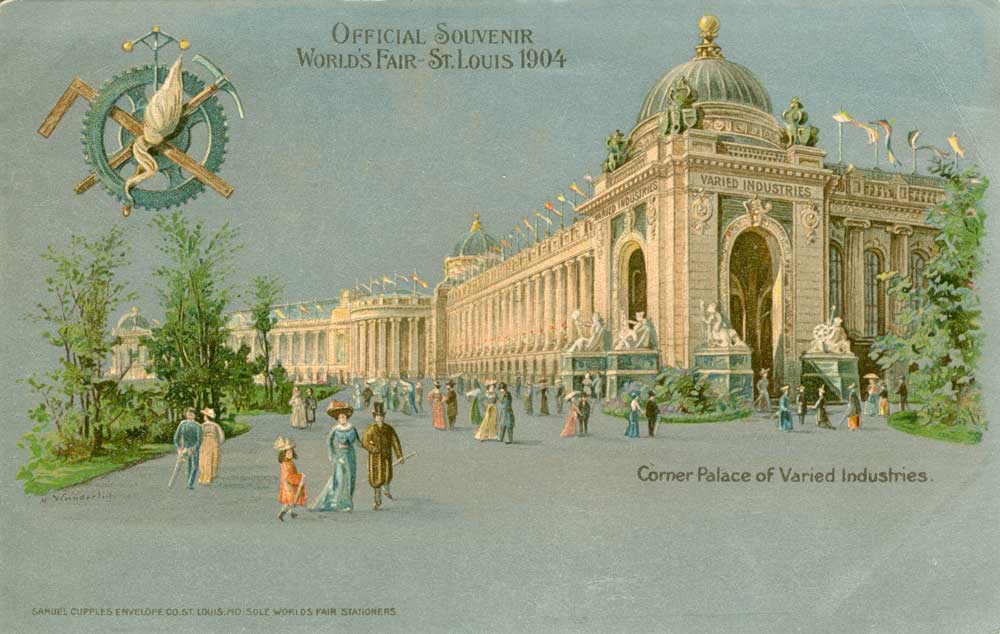
The fair dwarfed its predecessors, taking up 1,275 acres. The four expositions that came before it, even when combined, took up just over 1,300 acres. In the “Palace of Varied Industries,” attendees could view the works of every type of craftsman, from glassmakers to sculptors to silversmiths. The “Palace of Transportation” gave the crowd plenty to gawk at, including the latest mode of transportation—the automobile. For those wondering what the Liberty Bell really looked like, there it was, on view in the Pennsylvania State Building. Also at the Fair: the log cabin where Abraham Lincoln spent his childhood. . . the “Observation Wheel” (better known as the “Ferris Wheel”), which had taken its first spin at the Chicago Fair of 1893. . .and the 122-foot-wide “Great Floral Clock.”

The thrills continued unabated as fairgoers breathlessly strolled the “Pike” (1904’s equivalent of today’s “Midway”). Rides included “Shoot The Chutes” (for those who didn’t mind getting sopped in the pool at is base), but the Pike’s primary draws were its not-to-be-seen-anywhere-else attractions. Among them:
• “From New York to the North Pole,” a simulated sea voyage to the Arctic, complete with sub-zero temps and “warming beverages.”
• “Hale’s Great Fire Exhibition.” The destruction of a tall tenement house was re-enacted, complete with thrilling rescues.
• The “Baby Incubator,” occupied not by baby chickens but by human babies (attended, fortunately, by actual nurses).
• The “Hereafter,” a lurid tour through the afterlife, headlined by an encounter with “his Satanic Majesty,” followed by a welcome escape to “the Gates of Paradise.”
• The “Streets of Cairo,” where exotic dancer “Little Egypt” held sway (literally).

Learning the ABCs, graphite, and watercolour

Souvenir Postcard

Souvenir postcard from the “Corner Palace of Varied Industries” at the St. Louis World’s Fair.
$10-15. (Image courtesy of DBJ/HCK Pix)


Learning the ABCs, graphite, and watercolour

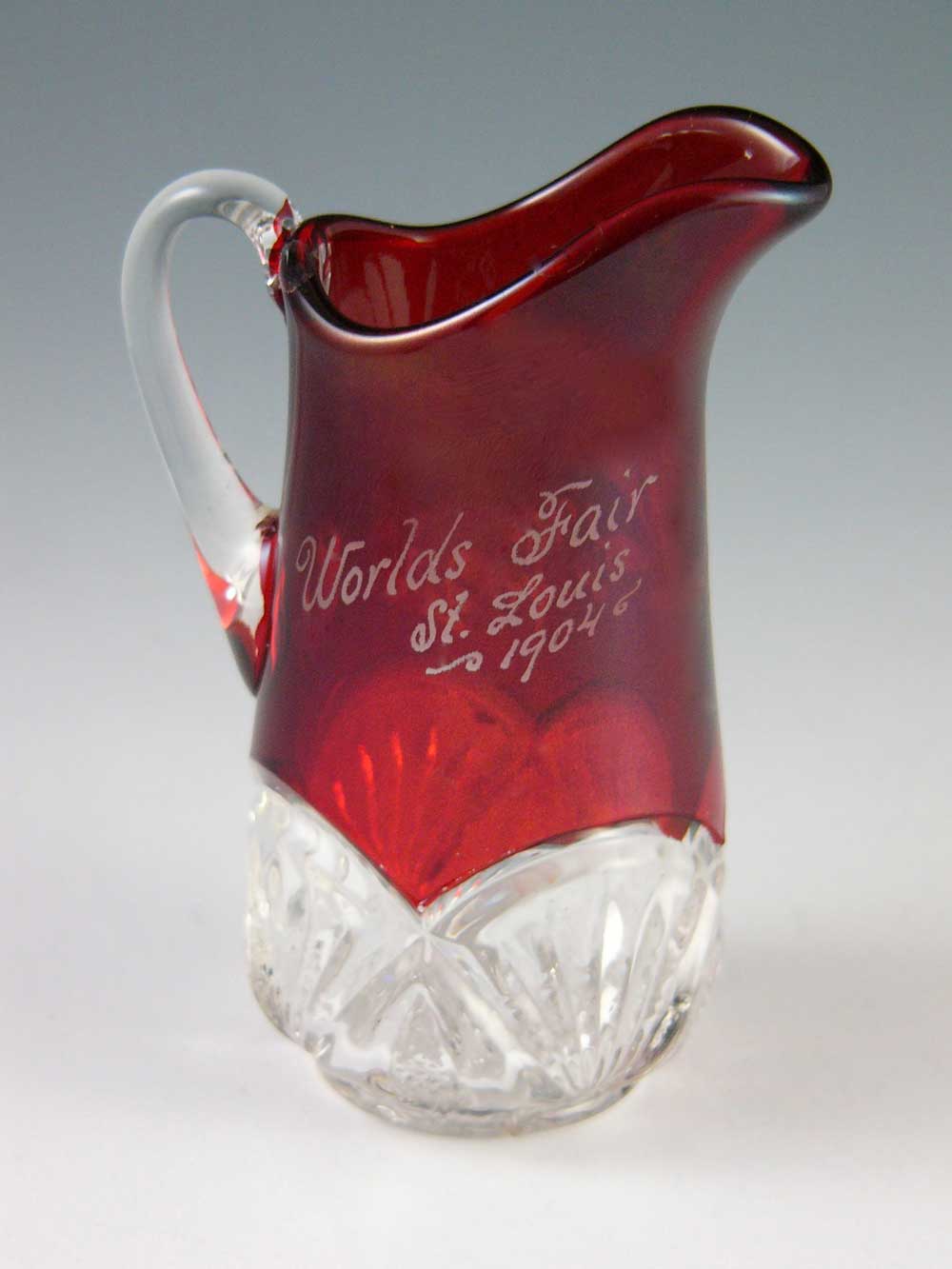
Engraved cranberry and crystal “flash glass”

Engraved cranberry and crystal “flash glass” was a fair favorite. Pitcher, 5” h., $50-75. (Pitcher courtesy of Jan McKelvie. Photo by DBJ/HCK Pix)


For the by-now-famished, there were also plenty of new taste treats to experience: hot dogs, iced tea, peanut butter, cotton candy, Puffed Wheat, Dr. Pepper, and the ice cream cone.

For today’s collectors, souvenirs of the St. Louis World’s Fair are a never-ending treasure trove. There are paper goods, including postcards, sheet music and posters. Hard goods proliferated, too, such as china sets with illustrations of Fair landmarks. Inscribed ruby/crystal “flash glass” items were a signature Fair souvenir, offering the look of luxury at bargain prices. Among the multitude of other Fair memorabilia: clocks, spoons, pin boxes, steins, paperweights, dresser boxes, hand-painted shells, pipes, hand mirrors, trays, letter openers, and stereopticon viewers, complete with fair-themed photo cards.

Why does the St. Louis World’s Fair continue to intrigue us? Well, in the word of one dazzled fair visitor, as quoted in the event’s daily Bulletin, “a week at the Exposition is better than a year’s travel around the world!” Or, as that unforgettable Mills and Sterling song put it, “don’t tell me the lights are shining, anyplace but there!”


Donald-Brian Johnson is the co-author of numerous Schiffer books on design and collectibles, including “Postwar Pop,” a collection of his columns. Please address inquiries to: donaldbrian@msn.com