This month: ‘Just an old Christmas card’

December 2023

SMACK DAB IN THE MIDDLE

This month: 'Just an old Christmas card'

by Donald-Brian Johnson

Here’s when the Christmas season really gets underway: one wintry day, amongst the deluge of bills and ads, your daily mail coughs up something out of the ordinary. Maybe it’s an envelope dotted with stenciled snowflakes. Maybe there’s a grinning snowman on an address label. But you know, even before opening it, exactly what you’ve received. It’s your first Christmas card. Let the holidays begin!

Commercially-produced Christmas cards first came to us courtesy of Sir Henry Cole, director of London’s Victoria & Albert Museum.

Cole had a tradition of sending handwritten holiday greetings to family and friends, but by 1843 the list was lengthy. Inspiration struck: he commissioned John Calcott Horsley, a member of the Royal Academy, to create a card that could be lithographed and colored by hand. “Extras” in the initial printing of 1,000 were then made available for sale to the general public.

Horsley’s 3” x 5” card illustrated three scenes: A family enjoying a holiday toast filled the central panel; the side panels featured folks performing charitable acts. The cards were roundly condemned, however, because one figure shown sipping wine in the central panel was a child. They were quickly withdrawn from the market; today, only about a dozen remain.

Over the next several years, the custom of card exchange grew in popularity, although initially only the wealthy could afford them. Then, thanks to the use of less costly paper and the development of the steam printing press, production costs plummeted. And, thanks to England’s Postal Act of 1840, even mailing a Christmas card was extremely affordable: postage was just a penny to anywhere in the United Kingdom.

In the United States, those sending “season’s greetings” had to make do with imported cards until 1875. That’s when Louis Prang, the “Father of the American Christmas Card,” began to sell them domestically. Prang’s “chromos” utilized zinc plates, which proved much less expensive than previous methods of color printing. The Christmas card tradition caught on here just as quickly as it had overseas; by the 1880s, Prang produced nearly five million cards annually.

By the 1920s, the Christmas card thematic pattern had become well-established, offering up a unique blend of nostalgia, sentiment, and season-specific visuals. Holiday wishes became particularly poignant during World War II, as greetings were sent to those overseas, keeping morale high, both at home and abroad.
 

Learning the ABCs, graphite, and watercolour

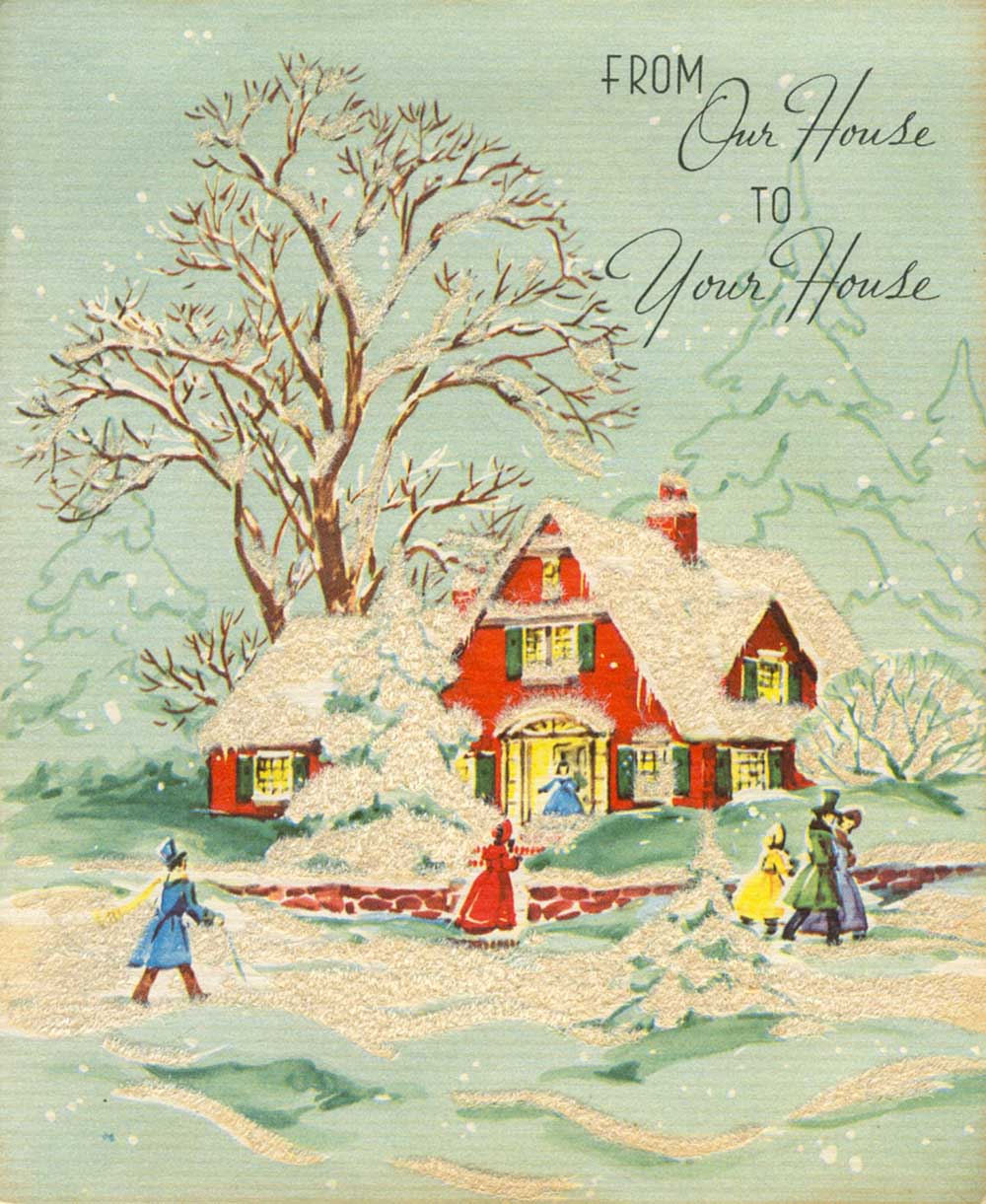
“From Our House To Your House”

A Christmas greeting that never grows old: “From Our House To Your House,” by A & W, early 1950s. The homes are festooned with flocked snow. Image courtesy of Donald-Brian Johnson and Hank Kuhlman


Learning the ABCs, graphite, and watercolour

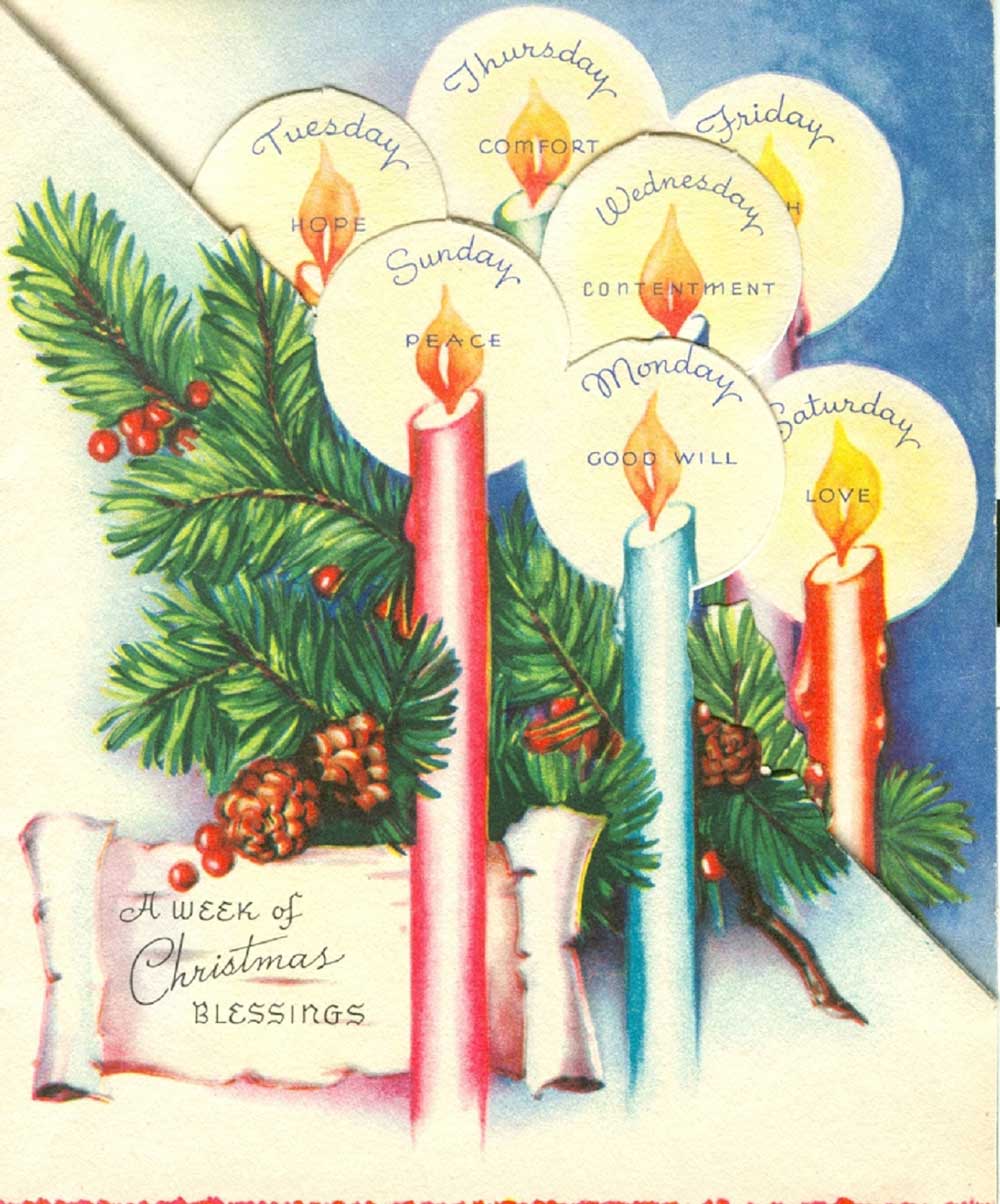
Week Of Christmas Blessings

Each candle on this early-1950s “Week Of Christmas Blessings” offers a different wish. Among them: “Hope,” Peace,” and “Good Will.” Image courtesy of Donald-Brian Johnson and Hank Kuhlman


While later cards incorporated photo art, those of the 1940s and ‘50s relied mainly on illustration. Novelty additions, such as glitter, flocking, window cut-outs, pop-ups, and pull-out tabs were often used. Card trim could include everything from lace ribbon bows to cotton snowdrifts to metallic foil accents.

Photo Cards

Today, many families wouldn’t consider a Christmas card complete without a family photo. The fad began in the late 1930s, with amateur black-and-whites adorning semi-glossy one-sheets.

Studio Cards

More upscale than a box of dime store holiday cards, the “studio card” of the 1950s and ‘60s provided understated elegance at overstated cost. Each season’s selection was displayed to prospective buyers in humungous “sample books.”

Hi Brows

Instantly recognizable by their tall and narrow shape, “Hi Brows” were introduced by American Greetings in 1957. The “Hi Brow” deconstructed the traditional Christmas greeting, reconfiguring it as hip and offbeat, with just a dash of snarky humor.
Over the decades, Christmas cards have been prized, not only for their individual, intrinsic charm, but also for the nostalgic memories they evoke. Memories, if not of a time we personally recall, at least of a time we’ve heard about, or read about, or dreamed about. Arranged individually, or as part of a larger holiday display, vintage Christmas cards remain an extremely affordable collectible; most average well under $15. They also provide an ongoing visual impetus for peace and good will, not just at Christmastime, but year-round.

The mail is here--and so’s that first card. Merry Christmas to all!


Donald-Brian Johnson is the co-author of numerous Schiffer books on design and collectibles, including “Postwar Pop,” a collection of his columns. Please address inquiries to: donaldbrian@msn.com
This month: ‘Heads Up! Character Wall Masks by Bossons’

November 2023

SMACK DAB IN THE MIDDLE

This month: ‘Heads Up! Character Wall Masks by Bossons’

by Donald-Brian Johnson

Ever wanted to study a “Tyrolean” up close? How about a “Smuggler?” A “Fisherman?” A “Fiji Islander?”

For collectors of Bossons Character Masks, opportunities like those are as close as checking out what’s hanging on the wall. There, in all their ethnic or character-inspired glory, are three-dimensional “heads,” celebrating the world’s diversity. There are characters from countries read about, yet still to be visited (“The Himalayan”; “The Corsican”; “The Rumanian”). Denizens of the Wild West (“Rawhide”; “The Old Timer”; “Tecumseh”). Working folk from all walks of life (“The Chef”; “The Lifeboatman”; “The Clown”). Ray Bossons’ intricately-detailed depictions run the global gamut, each encapsulating, in just about 6 inches, the essence of their subjects.
Unlike wall-mount “lady head vases,” which have an opening for flowers in the crown of the lady’s oversize hat, Bossons heads are solid plaster. The firm’s publicity referred to them as “wall masks,” which hits it right on the head. Not Halloween masks. Not pandemic masks. These are “life masks,” capturing facial likenesses with as much precision as possible.

Based in Congleton, England, the company was founded shortly after World War II by W. H. Bossons. With an extensive background in ceramics and tile work, W.H. saw a future in the manufacture of decorative plaster items. Following military service, son W. “Ray” Bossons joined the firm. A trained potter with considerable marketing experience, Ray became Bossons’ principal designer.
Plaster art had long been dismissed as a “poor man’s marble,” especially by those who could afford the real thing. For those who couldn’t (which included most prospective Bossons customers), attractive home décor items at attractive prices were just the ticket. Not “the real thing?” They were the next best thing, and that was good enough.

Bossons early success came with the release of high-relief plaques celebrating “Beautiful Britain,” from “Shakespeare’s Birthplace” to “Salisbury Cathedral.” Ranging in size from small “plaquettes” to whopping 14” rounds, the hand-painted plaques, with their sculpted three-dimensional highlights, brought a touch of class to any home (Most of those homes, incidentally, were outside of Great Britain. Due to a domestic sales tax of 125 percent, exports over the years accounted for almost 75 percent of Bossons’ business).

Bossons plaques and products were easy to find. If fine jewelry stores turned up their noses, there were plenty of other options: gift and collectible shops, tobacco shops, and souvenir shops on cruise ships. There was soon a bounty of Bossons products to choose from, including shelf ornaments, mirrors, barometers, thermometers, book ends, and lamp bases. In addition to scenic views, the 3-D variety encompassed everything from floral groupings to hunting scenes. And then, of course, there were the heads.

Learning the ABCs, graphite, and watercolour

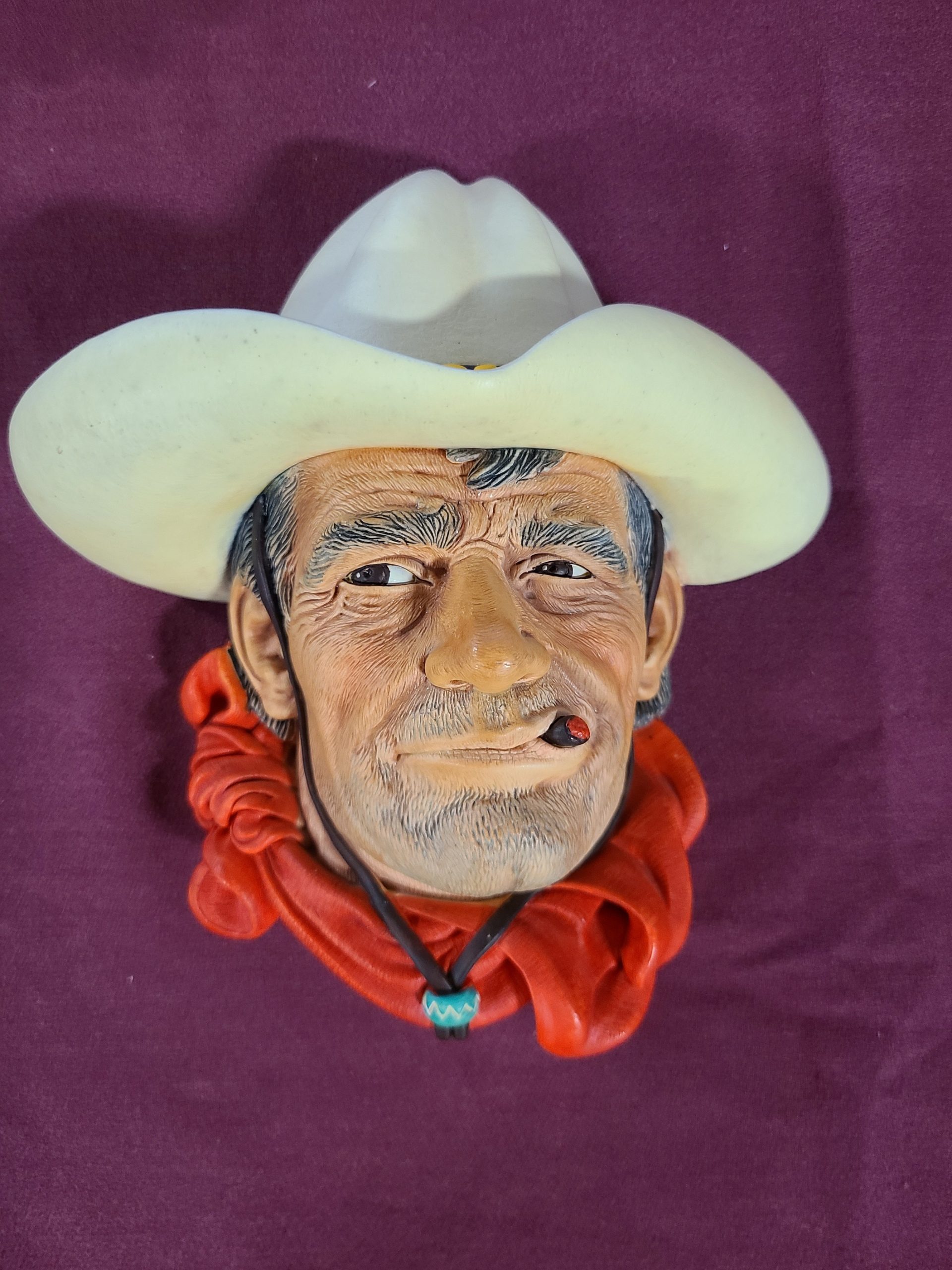
Rawhide

“Rawhide,” 1968. Image courtesy of the author and Hank Kuhlmann. Bossons heads courtesy of Doug (Pete) Petersen (djtoysandtreasures@gmail.com


Learning the ABCs, graphite, and watercolour

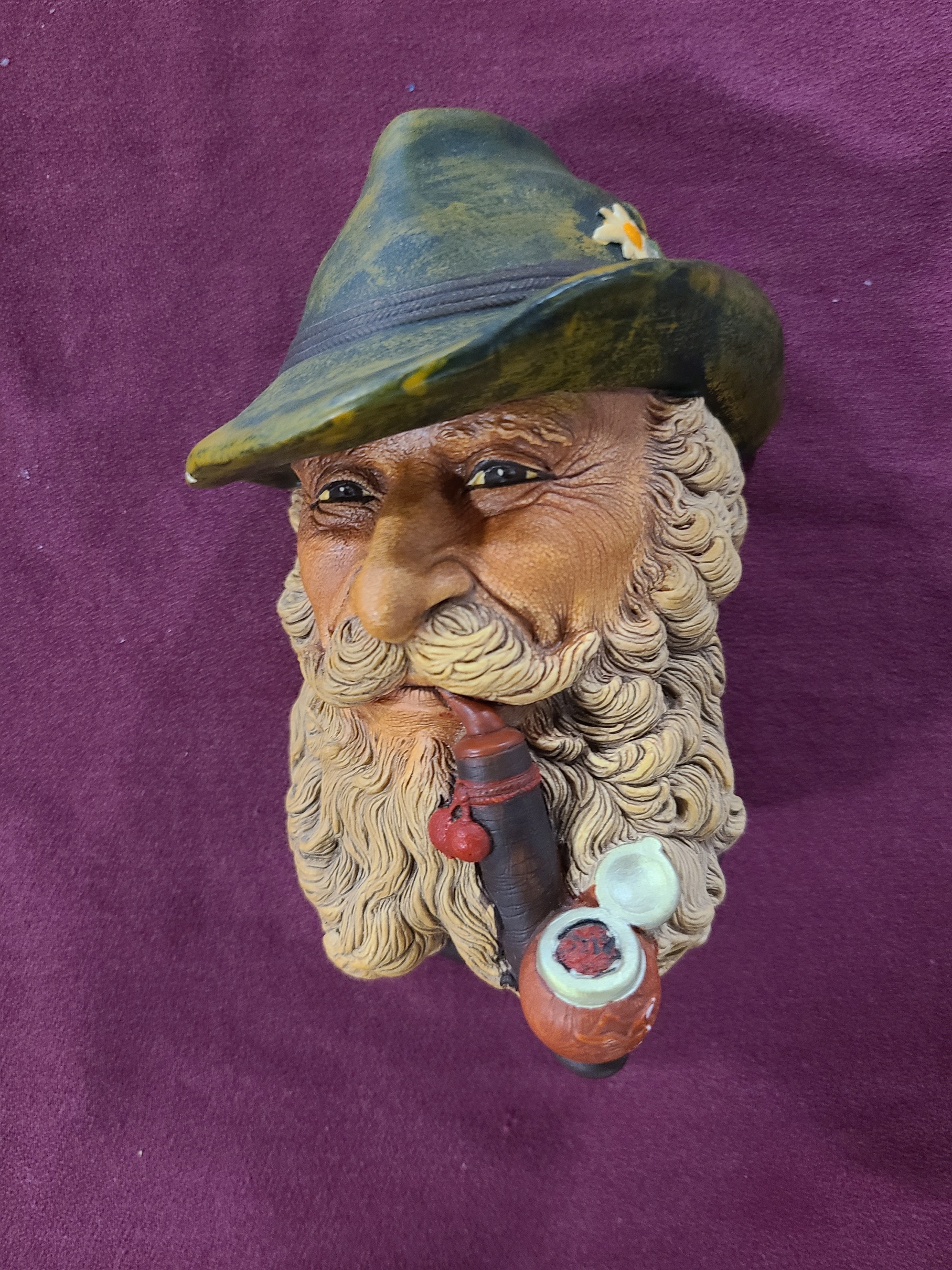
Tyrolean

“Tyrolean,” 1972. Image courtesy of the author and Hank Kuhlmann. Bossons heads courtesy of Doug (Pete) Petersen (djtoysandtreasures@gmail.com).


Ray Bossons designed his initial “Character Wall Mask” in 1958 (a “Snake Charmer”). The masks made their official debut in the 1959 catalog. From then on, Bossons masks were at the head of the company line. Each year’s catalog introduced new members of the Bossons community, and consumers couldn’t get enough. In addition to character and ethnic heads, there were animal and bird heads; heads modeled after fictional characters (including a generous assortment of Charles Dickens’ all-stars, from “Mr. Pickwick” to “Ebenezer Scrooge”); and even the occasional historical favorite, such as Sir Winston Churchill. While other modelers were employed over the years, the design impetus always came from Ray Bossons. If a mask wasn’t yet deemed ready for release, it was held back.

In 1996, Bossons ceased operations. Since then, appreciation for Bossons masks, and the company’s other plaster and pottery products, has been the realm of a devoted band of collectors. Annual conventions are held, two Bossons books have been written, and nearly 1,500 Bossons heads are available on eBay each day. Of those, the majority have a “buy-it-now” price of under $50. As in the past, Bossons prices remain as attractive as Bossons masks. In other words, head and shoulders above the competition.


Donald-Brian Johnson is the co-author of numerous Schiffer books on design and collectibles, including “Postwar Pop,” a collection of his columns. Please address inquiries to: donaldbrian@msn.com
This month: ‘A Vogue for Vogue’

October 2023

SMACK DAB IN THE MIDDLE

This month: ‘A Vogue for Vogue’

by Donald-Brian Johnson

Downbeat magazine called them “the discs that sparkle with color.” Gimbel’s trumpeted their “new and wonderful” arrival with a full-page ad in The New York Herald Tribune. Sears, Roebuck touted them as “amazing—with some of the most sensational improvements ever made in the history of phonograph records!”

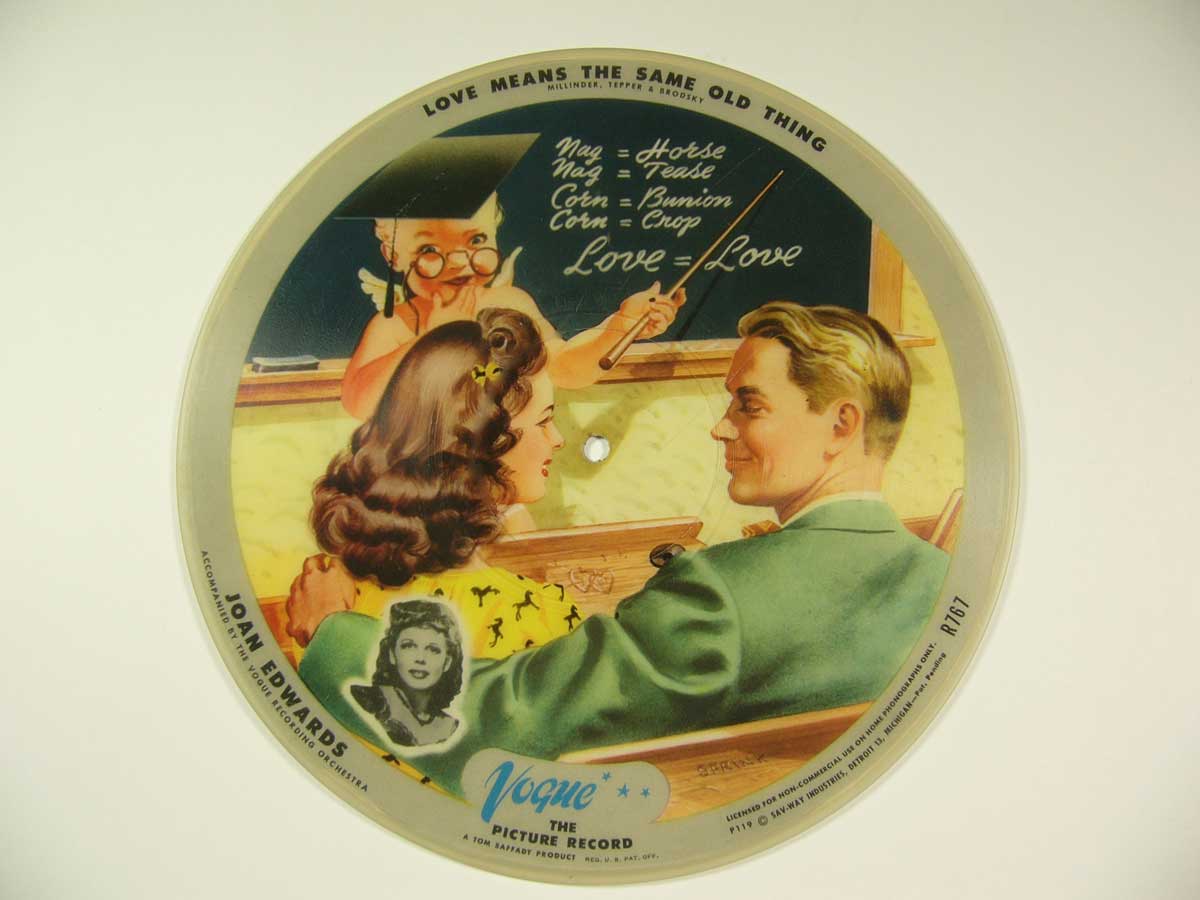
The subject of all the talk? Vogue picture records, those illustrated musical curiosities that have retained a unique appeal for over 75 years. Picture discs preceded Vogue, with Noel Coward, Paul Whiteman, and the cast of Music in the Air all depicted on records of the 1920s and ‘30s. They’ve also continued into the present, with vinyl visuals devoted to Elvis, the Beatles, and even Snow White. Vogue, however, brought picture records to the forefront.

Although the company’s heyday was brief, (from early 1946 through mid-1947), the Vogue catalog serves as a colorful time capsule of the post-World War II era. While Billboard dismissed Vogue illustrations as “strictly of the coal company calendar type,” the scenes depicted, (often romantic, patriotic, or humorous), retain a freshness and optimism totally in keeping with the spirit of mid-1940s America.

The visionary behind Vogue was 29-year-old Tom Saffady, president of Detroit’s Sav-Way Industries. Saffady’s dream: an “unbreakable” picture record, replacing easily-shattered shellac discs. Each 10-inch Vogue 78 had an interior aluminum core bonded to Sav-Way’s transparent Vinylite plastic. In addition to increasing durability, the aluminum core also made the records warp-proof, while the plastic reduced surface and needle noise.

All production, except label printing, was centered at Vogue’s Detroit plant. A Saffady-invented automatic record pressing carousel dramatically sped up record production, with discs stamped out some 80 times faster than before. There was also a complete in-house recording studio, plus a nearby Saffady-owned nightclub, where Vogue acts could perform when not busy cutting records for the label.

Learning the ABCs, graphite, and watercolour

Ouch!

Ouch! #R731, “Between the Devil and the Deep Blue Sea,” Marion Mann. $100-$125. (Image courtesy of the author and photo associate Hank Kuhlmann)


Learning the ABCs, graphite, and watercolour

Warming up Winter

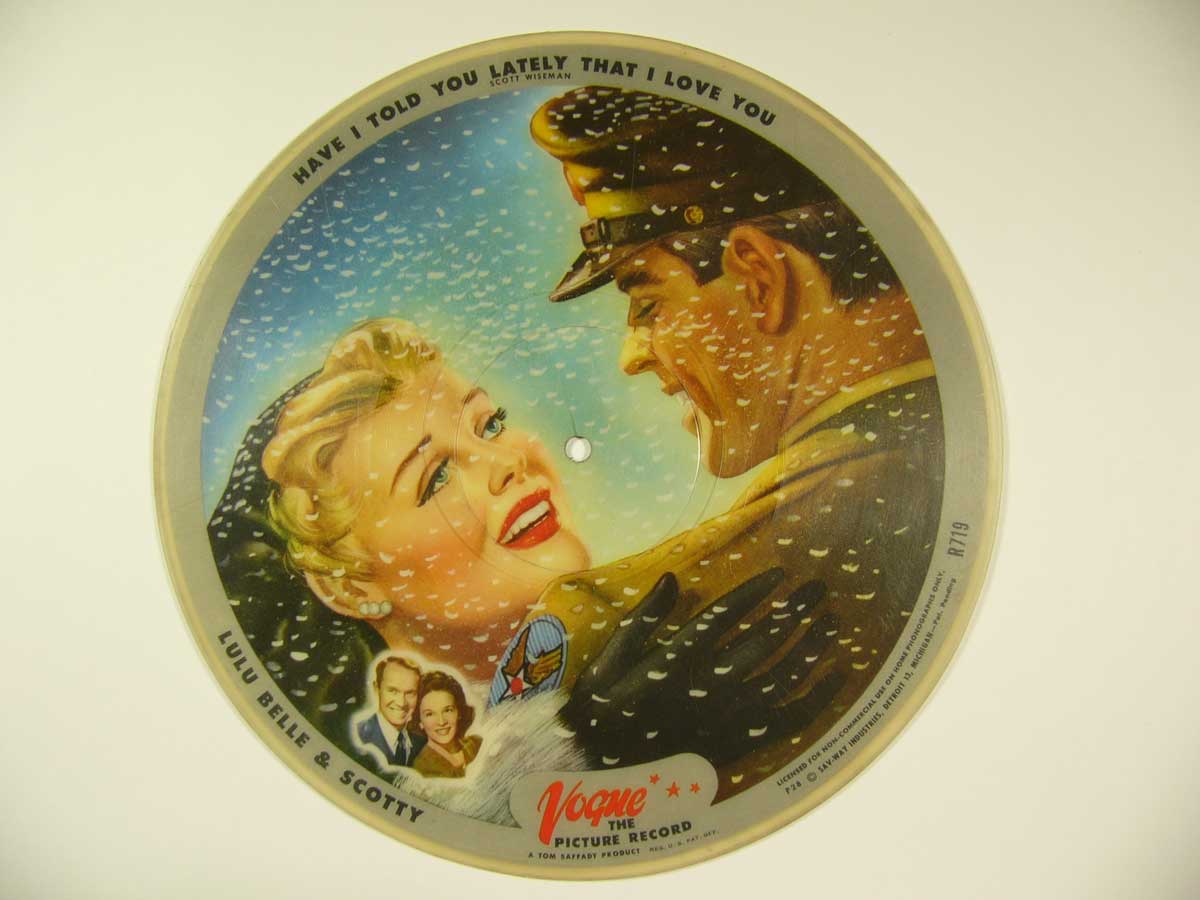
Warming up winter: #R 719, “Have I Told You Lately That I Love You?” by Lulu Belle & Scotty. $75-$100. (Image courtesy of the author and photo associate Hank Kuhlmann)


The Vogue roster included such musical luminaries of the time as Clyde McCoy, the Charlie Shavers Quintet, Patsy Montana, and Phil Spitalny’s All-Girl Orchestra, but Saffady was unable to sign such top-tier performers as Frank Sinatra and Bing Crosby. Since Vogues were priced at just over a dollar, (about twice the going rate for a traditional 78), buyers wanted more than just an illustrated, unbreakable record: they wanted a hit, which Vogue could not provide. Hampered by declining sales and high overhead, Saffady filed for bankruptcy in August 1947.

His picture discs, however, live on. In recent years, the records have become popular with collectors worldwide. Few are lured by the actual recordings themselves (“Does anyone,” said one collector, “actually play a Vogue record?”) The artwork is what draws us in, combining elements of Hollywood glamour, pinup art, old-fashioned unabashed sentiment, and just a touch of all-American 1940s whimsy. That unique visual style came courtesy of artists Ruth Corbett, Walter Sprink, Richard Harker, Will Wirts, M. Kanouse. and R. Forbes. Thanks to the impenetrability of the Vinylite coating, many of their Vogue illustrations retain colors as vibrant as the day they were first pressed.

Approximately 75 recordings, (not all consecutive numbers), were issued in the Vogue “R700” series; all but a handful show up with regularity on the secondary market. Collectors drawn to the themes and the colors of a Vogue record also get “two for the price of one,” since each side features a different illustration. Whether framed, displayed on plate stands, or hung on a wall, the flip side of a Vogue can easily be viewed whenever the mood strikes. (A limited series of black-rimmed Vogue vinyl facsimiles, released in later years by Bear Family Records, should not be confused with the originals.)

In 1946, as Vogue picture records took their first bow, Gimbel’s proclaimed them “just right for collectors, jitterbugs, old tune hummers, and all the other disc devotees of America.” Today, long after the Vogue turntables stilled, the “Recordings With Color”—Tom Saffady’s personal dream—remain as colorful and dream-inspiring as ever.


Donald-Brian Johnson is the co-author of numerous Schiffer books on design and collectibles, including “Postwar Pop,” a collection of his columns. Please address inquiries to: donaldbrian@msn.com
Shell Games: Creative projects extend that summer feeling

September 2023

SMACK DAB IN THE MIDDLE

Shell Games: Creative projects extend that summer feeling

by Donald-Brian Johnson

Admit it: those lazy, hazy, crazy days of summer are OVER. Autumn’s here. Time to rinse out the swimsuits, deflate the floaties, and figure out what to do with that beach bag bulging with souvenir sea shells. Hmmm...
Well, you could always make something.

No kidding. Items made entirely of shells, covered with shells, or just dotted with the occasional accent shell, have been tops as summery souvenirs since at least the 1700s. In 1703, a London woman offered her services as an instructor in the delicate art of “shell work in flowers, sconces, and rocks.” Mary Granville Delany, another turn-of-the-18th-century Londoner, was renowned for her challenging shell projects. Among them: a chapel ceiling, with shells woven into a pattern resembling flower garlands. The fascination with shell craft as a refined art form continued well into the Victorian era. The 1876 guide “Ladies’ Fancy Work” offered detailed instructions (plus glue recipes) for using shells to form “exquisitely beautiful articles of adornment for parlor or dressing table.” As one British publication of the time put it, shells were “so brightly clean, so ornamental to a boudoir” that shell craft was a pursuit “peculiarly suited to the ladies.”

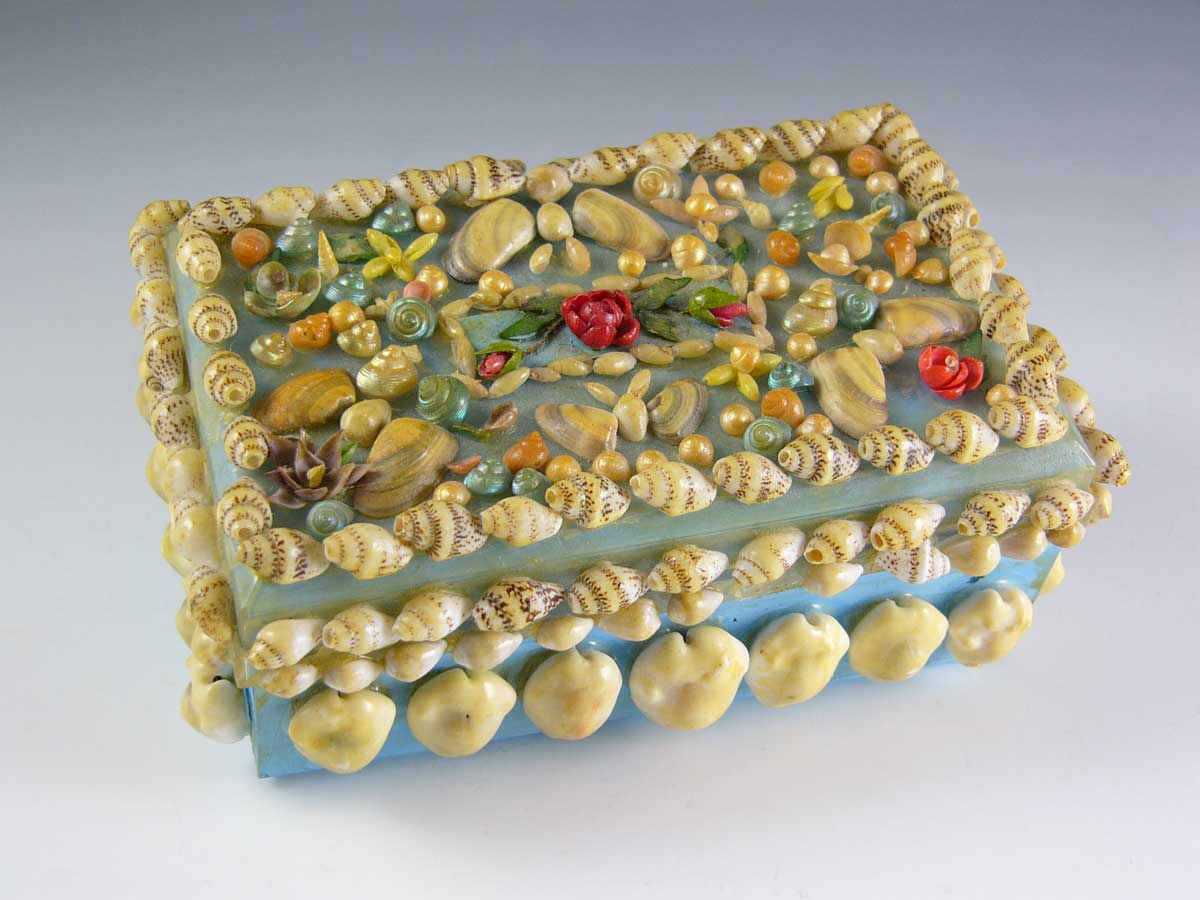
Tell that to the Marines. During the 1800s, many seafaring men brought “sailor’s valentines” to the girls back home. These octagonal wooden boxes had covers decorated with elaborate shell designs. Appropriate sentiments (e.g., “To My Sweetheart”), were picked out in shells of a contrasting color. Romantic legend has it that, in their downtime, these water-weary voyagers not only carved the boxes, but also came up with their intricate shell-patterned lids. Just another way of whiling away the hours between monsoons.

A more likely (if less sigh-inducing) theory is that even the Ancient Mariner, after spending months at sea, knew better than to return to his sweetheart empty-handed. Last-minute peace offerings were called for, and the Caribbean craftsmen of Barbados were happy to oblige. The labels found on many “sailor’s valentines” list their actual source as “Native Manufacturers in Fancy Work.”

By the mid-20th century, sailors were no longer crafting (or at any rate purchasing) their valentines, and other forms of shell art had become a bit less refined. Now, any gift shop claiming even the slightest proximity to water wasn’t complete without a shellcraft selection. Vacationers loved shell souvenirs. They were fun to look at, and cleverly made. They were inexpensive, so no need to shell out a bundle. And best of all, travelers could take them home and display them on the mantel. It was an unobtrusive way of telling the neighbors, “Guess where WE went this summer?”

Learning the ABCs, graphite, and watercolour

A shell-decorated box

In the style of a sailor’s valentine: a shell box from the South Pacific, dating from World War II, in a jaunty shade of ocean blue. 3-12” w. x 5-1/2” l. Shell art courtesy of Maureen Maher and Jan Andreasen. (Image courtesy of the author and Hank Kuhlmann)


Learning the ABCs, graphite, and watercolour

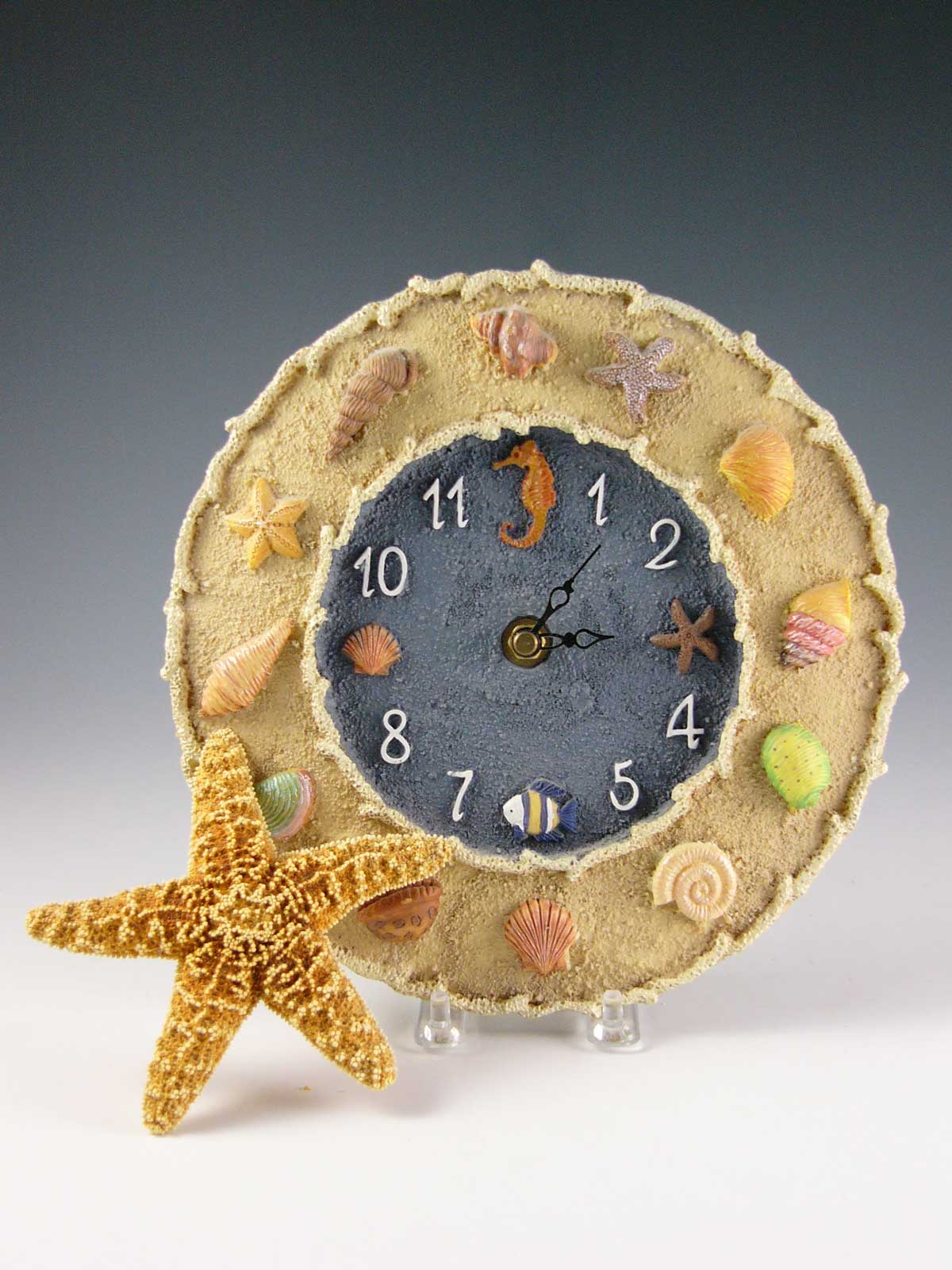
A shell-decorated clock

What time is high tide? Shell-decorated clock, with companion starfish. 9” d. Shell art courtesy of Maureen Maher and Jan Andreasen. (Image courtesy of the author and Hank Kuhlmann)


And what a variety to choose from! There were shell-covered boxes (a nod to the “sailor’s valentines”) shell paperweights, shell trinket holders, perfume bottles, mini-Christmas trees, and picture frames. How about shell coasters? Wreaths? Crosses and clocks? Soap dispensers and hanging planters? Luck onto the right shop, and you just might head home with a shell lamp, a shell sailing ship, even a litter of shell cats, or a combo of shell musicians. Pick more than two, and you could consider yourself a full-fledged conchylomaniac (in layman’s terms, an insatiable shell collector).

Fortunately, the mania to collect shell art is a relatively inexpensive one. Most examples can be found today for under $25, which will leave few buyers shell-shocked. That’s a far cry from the value placed on shells in centuries past. In the 1600s, one Dutch collector amassed more than 2,000 of them, which he kept locked in a treasure chest. To open the shell chest required three separate keys, each entrusted to a different person. Roemer Visscher, a Dutch contemporary, wrote that shells from distant lands had suddenly become as valuable as jewels. “It is bizarre,” said Visscher, “what a madman spends his money on.”
Gee. And those shells hadn’t even been turned into lamps.


Donald-Brian Johnson is the co-author of numerous Schiffer books on design and collectibles, including “Postwar Pop,” a collection of his columns. Please address inquiries to: donaldbrian@msn.com
Chalk Talk: Collecting Carnival Chalkware

August 2023

SMACK DAB IN THE MIDDLE

Chalk Talk: Collecting Carnival Chalkware

by Donald-Brian Johnson

“Hey there, fella! Step right up and take yer chance! Knock down the milk bottles, and win a kewpie for your girlie! All it takes is one thin dime!”

Lines like that have been circulating around carnivals for years... and over those years, lots of fellas have been falling for it. Usually, it took plenty more than “one thin dime” to knock over those bottles, but eventually, down they went. The determined, now dimeless, player (or more likely, his “girlie”), proceeded merrily down the midway, the proud possessor of a chalk-ware “kewpie doll.”

While oversized stuffed animals rule the fairground roost today, it wasn’t always so. During the heyday of traveling carnivals, from the Depression years of the 1930s well into the 1950s, chalkware figurines were the sought-after prizes in games of chance. Originally called “kewpie dolls,” after the Rose O’Neil impish bald-headed cherubs which populated their ranks, chalkware characters actually came in many guises. There were quaint animals, from piggy bank pigs to pipe-smoking chimps … jolly clowns and seductive “sweater girls”… patriotic portrayals of George Washington and Native Americans… plus pop-culture favorites, ranging from the Lone Ranger to the Easter Bunny.

Carnival-goers loved chalkware figurines because they were colorful and fun. Carnival operators loved them because they were inexpensive: a 1940 catalog, from novelty supplier Gellman Bros. of Minneapolis, listed a ‘Popeye” chalk lookalike for 13 cents (or just a few pennies over that “one thin dime”).

Before wending its way to the midway, chalkware had occupied a loftier spot. Dur-ing the 1800s and early 1900s, there were those who admired Staffordshire por-celain figurines, but were unable to afford them. Staffordshire-like chalk reproductions of elegant couples and docile animals proved an acceptable substitute. And, since chalk-ware was essentially molded plaster of Paris, cold-painted in watercolors or oils, the results fit almost every budget (Today, those early figurines, attributed to the Pennsylvania Dutch, are as sought-after as their porcelain predecessors).


Learning the ABCs, graphite, and watercolour

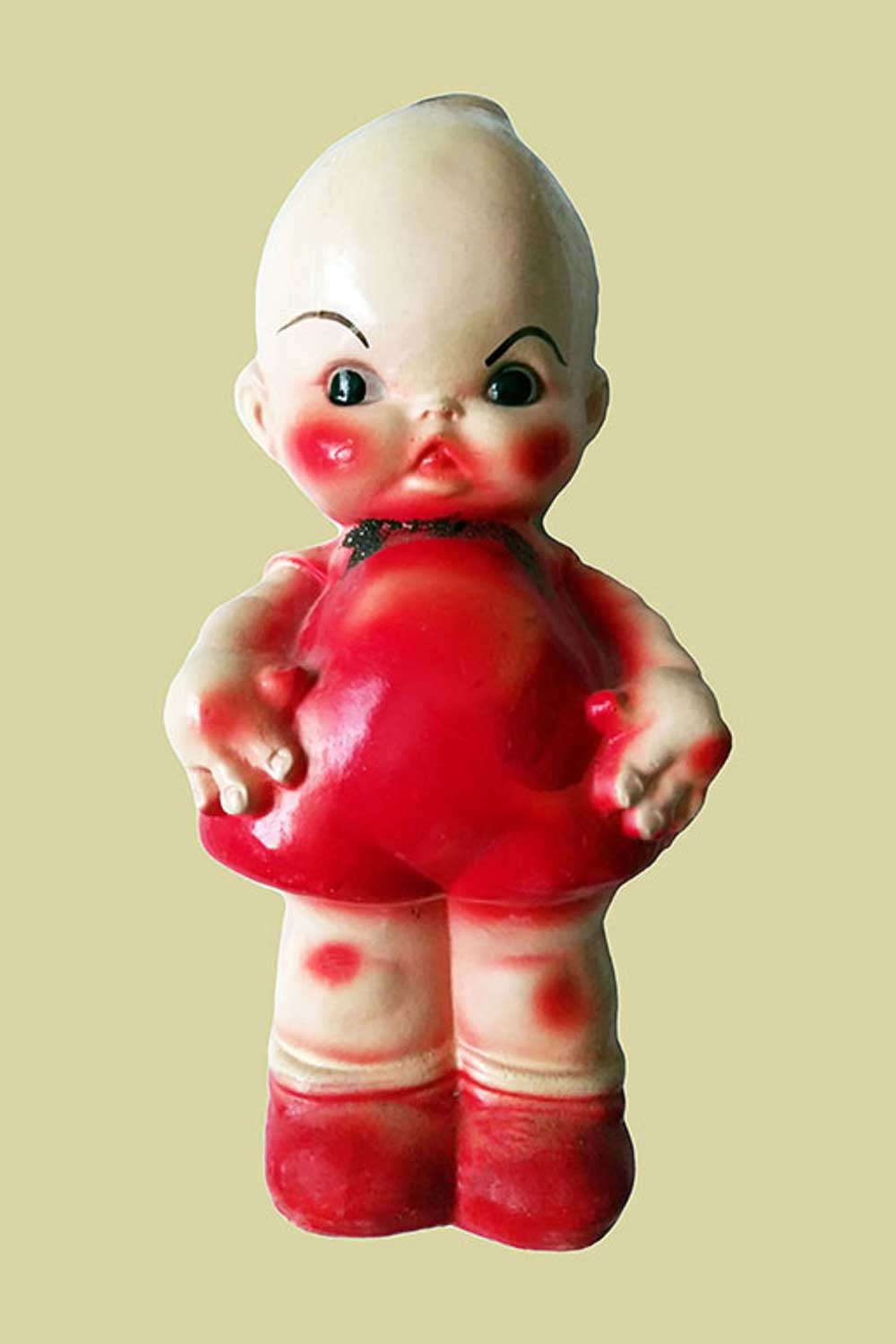
Chalkware Kewpie Doll

You can call her “Kewpie,” but according to the Gellman Bros. catalog she’s the “Snookie Doll.” (Image courtesy of the author and Hank Kuhlmann)


Learning the ABCs, graphite, and watercolour

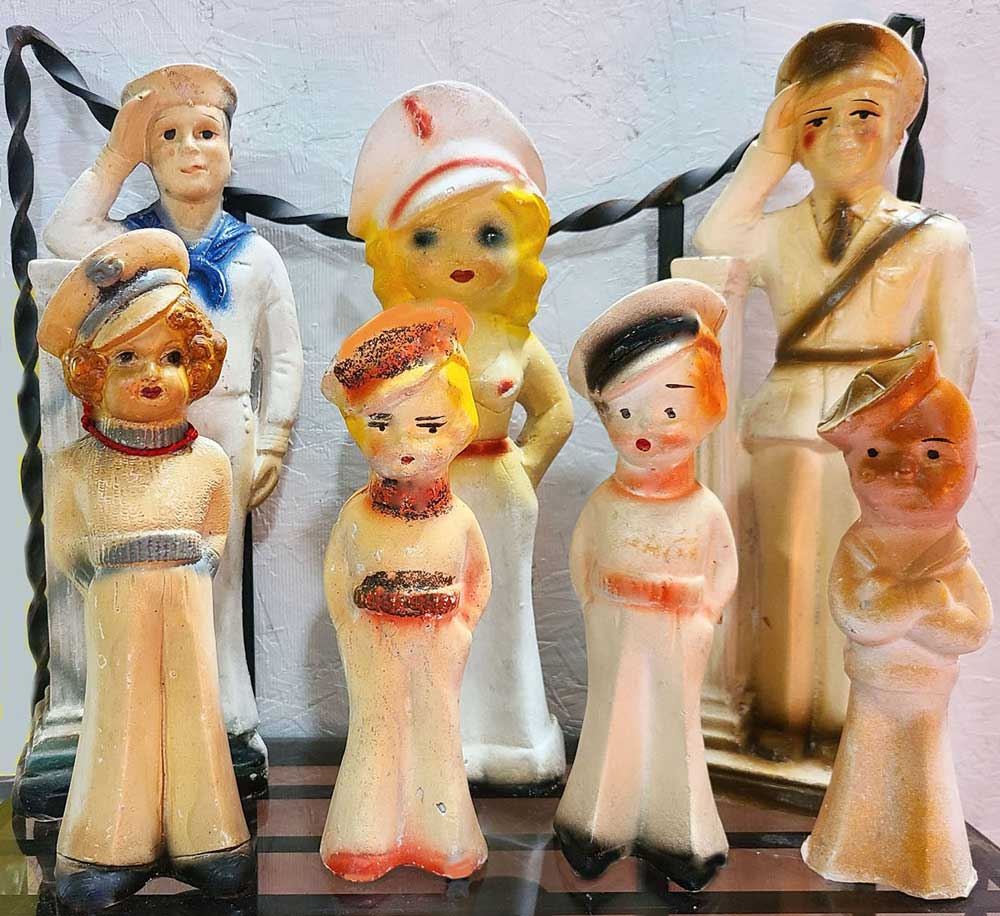
Chalkware Figurines

Parade rest: a lineup of chalkware figurines in patriotic attire. (Image courtesy of the author and Hank Kuhlmann)


Carnival chalkware occupied a less heady pla-teau. Representations of familiar personages, ani-mals, and things (like autos or sailing ships), were what the customer wanted, pre-ferably when those familiar faces were decked out in bright, eye-catching colors, with the occasional splash of glitter. Potential prize-winners were agog: “Look - there’s Rin Tin Tin! And Pinocchio! And over there are Charlie McCarthy and Snow White!” Licensing big names was never a problem for novelty suppliers. The figures may have looked exactly like their name-sakes, but company catalogs would have you believe differently. According to Gellman Bros., Rinty was “Rex the Police Dog,” Pinocchio was the “Comical Puppet,” Charlie McCarthy was “Talkie Dan,” and Snow White was “Miss Wonderland.” Even the Kewpie cherub was reborn as the “Snookie Doll.” Regardless of the name, customers knew what they were winning, and proprietors knew that they knew; the lack of licensing fees kept prices affordable.

Chalkware figurines came in a variety of sizes: “small” (5-8”); “medium” (8-10”); and “large” (11-18”). (The better the game player, the bigger the prize!). Some, like Charlie McCarthy, were produced in assorted sizes and colors. Prices for most figures remain remarkably low, starting at around $10 for those in not-so-nifty condition, up into the low hundreds for rarer figures. Also available, besides piggy banks: chalkware string dispensers, bookends, lamps, wall plaques, “nodders,” and even Christ-mas decorations.

A chalkware drawback is its fragility. Since it’s plaster, it chips. Since it’s cold-painted without glaz-ing, it fades. Chalkware can’t be washed, unless you want to remove even more color. So, collectors in search of mint chalkware figurines may need to resign themselves to a few (or, in the case of a hard-to-find piece, more than a few), imperfections.

But for chalkware connoisseurs, love is blind. Stocking your shelves with chalkware figures, even if in less-than-ideal condition, can summon up happy memories of bygone days. Best of all, you don’t have to knock over any milk bottles to get them.


Learning the ABCs, graphite, and watercolour

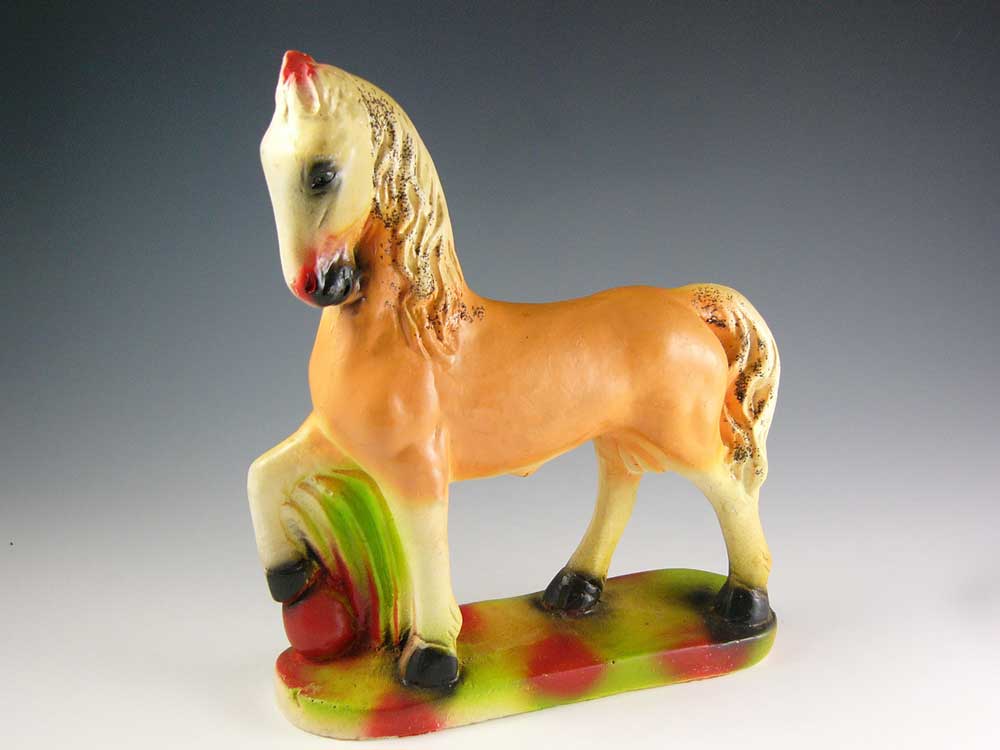
Chalkware Horse

Glitter accents on mane and tail add to the appeal of this chalkware horse. (Image courtesy of the author and Hank Kuhlmann)


Donald-Brian Johnson is the co-author of numerous Schiffer books on design and collectibles, including “Postwar Pop,” a collection of his columns. Please address inquiries to: donaldbrian@msn.com